Sometimes you stumble onto something on the internet that doesn’t just entertain you — it taps right into the part of your brain you thought had gone quiet.
That happened to me this week, thanks to a Matt Parker video and a puzzle that exists purely because 2025 is a mathematically beautiful year. A sequel to THE PATRIDGE PUZZLE, one might say.
So I thought… why not take you into my little spiral?
Let’s talk about squares, cubes, triangles — and a puzzle so complex that humans struggle with it, computers dominate it, and machine learning quietly enters the conversation.
2025 has a strange numerical charm.
It’s a perfect square:
2025 = 45 × 45
And 45 itself is a triangular number — the sum of:
1 + 2 + 3 + … + 9
Now comes the identity that ties everything together:
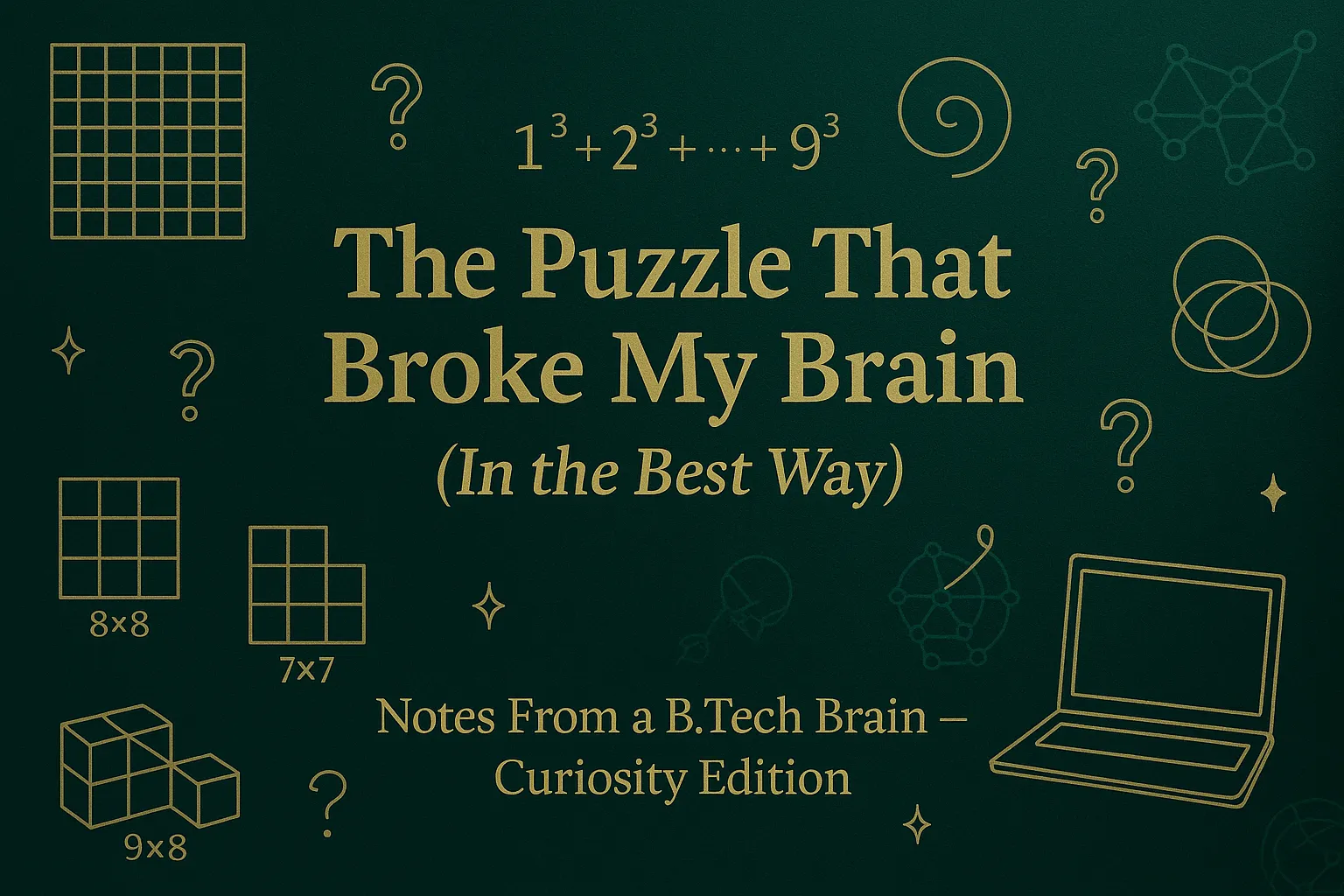
1³ + 2³ + 3³ + … + 9³ = 2025
A perfect square emerging from the sum of perfect cubes.
It’s rare. Elegant. Slightly absurd in the best way. The kind of thing that makes mathematicians smile for no practical reason except that the universe aligned neatly for once.
And this identity inspired a puzzle that is, honestly, gloriously insane.
Meet The Partridge Puzzle.
Using the fact that 2025 is the sum of cubes, you can build a 45×45 square using:
- 9 tiles of size 9×9
- 8 tiles of size 8×8
- …
- 1 tile of size 1×1
All of these pieces must fit together perfectly — no gaps, no overlaps. Just pure tiling of the entire grid.
And here’s the twist.
Humans find it extremely hard.
Even with logic, intuition, and puzzle instincts, the search space is so massive that one small mistake early on can ruin your solution ten steps later.
But computers?
They love this level of chaos.
Researchers wrote brute-force and optimized solvers to count how many valid tilings exist.
The answer?
Over 1.7 million solutions.
One puzzle. One giant square. Over a million ways to get it right.
But what fascinated me even more than the number of solutions was the story behind the puzzle itself.
The 45×45 installation shown in the video wasn’t just a YouTube prop. It was physically built inside the New York office of Jane Street, the quantitative trading firm known for its deep puzzle culture.
A trader there, Andy Neidmire, suggested turning the 2025 identity into a full physical puzzle. They manufactured it, installed it, and — unsurprisingly — everyone tried to solve it.
And failed.
So they did what they do best: they wrote code.
One employee reused old polycube-packing code from school to generate an initial solution after the physical attempts went nowhere. He then wrote a more optimized solver that solved the puzzle in seconds — a quiet but powerful demonstration of how computational thinking shines when brute intuition collapses.
Fun detail: Andy, the person who proposed the puzzle, is the only known human to have solved the 45² version by hand. Which is… terrifyingly impressive.
Now, to be clear — Jane Street did not train a neural network specifically to solve this tiling puzzle. But this story connects to something bigger.
Jane Street has a long-standing culture of puzzles as a way to find and train people who think deeply. They publish public math and computational puzzles regularly, use puzzle-solving in their hiring process, and even give candidates neural-network-based problems to observe how they think rather than what answer they produce.
Their ML teams focus heavily on understanding model behaviour instead of treating deep learning like a black box.
So while the 45×45 puzzle itself wasn’t an ML experiment, it’s exactly the kind of structured, rule-based, high-search-space environment where machine learning models thrive — and where intelligence, human or artificial, reveals its patterns.
That connection is what hooked me.
I study AI-ML, and I write because I like breaking things down until they make sense — taking the world apart into little squares and fitting them back together.
This puzzle sits right at the intersection of what I love:
math that feels like magic,
logic that behaves like art,
computer science that quietly flexes,
and machines that learn strategy, not just guesses.
It reminded me why I got into tech in the first place — to build things that feel impossible until they exist.
So will I build this myself?
Honestly… probably yes.
But in 2026. After exams. When life stops trying to speed-run chaos and I can actually give it the time it deserves.
I don’t want this to be a tiny one-page mini project. I want a full experience — a polished 45×45 interactive grid, draggable tiles, progress checks, solvability detection, hint modes based on difficulty, and a gentle ML model that gives intelligent nudges instead of spoilers.
Alongside a dev-journal series documenting everything: the math, the design, the failures, the breakthroughs, the neural nets that refuse to cooperate, the visualisations — all of it.
It’ll be huge. But I want to do it justice.
Until then, let this edition be your introduction to a puzzle that completely hijacked my brain this week.
If it hijacked yours too… welcome to the club.
Math doesn’t always need a purpose to be beautiful.
Sometimes it’s enough that something exists simply because the universe aligned a certain way — perfectly, neatly, accidentally poetic.
And sometimes, those coincidences spark ideas that grow into full projects, new skills, or entirely new versions of ourselves.
2025 may be a square.
But 2026… might be the year I try to solve it.
p.s. 25 of May, 2026: Sum of Cubes:The Partridge Puzzle