The Article That Stayed With Me
I woke up this morning to an article arguing that by using ChatGPT constantly, we are quietly outsourcing our thinking and “borrowing certainty.”
(read here : https://www.leravi.org/chatting-with-chatgpt-daily-weakens-moral-reasoning-18054/ )
One line, in particular, stayed with me:
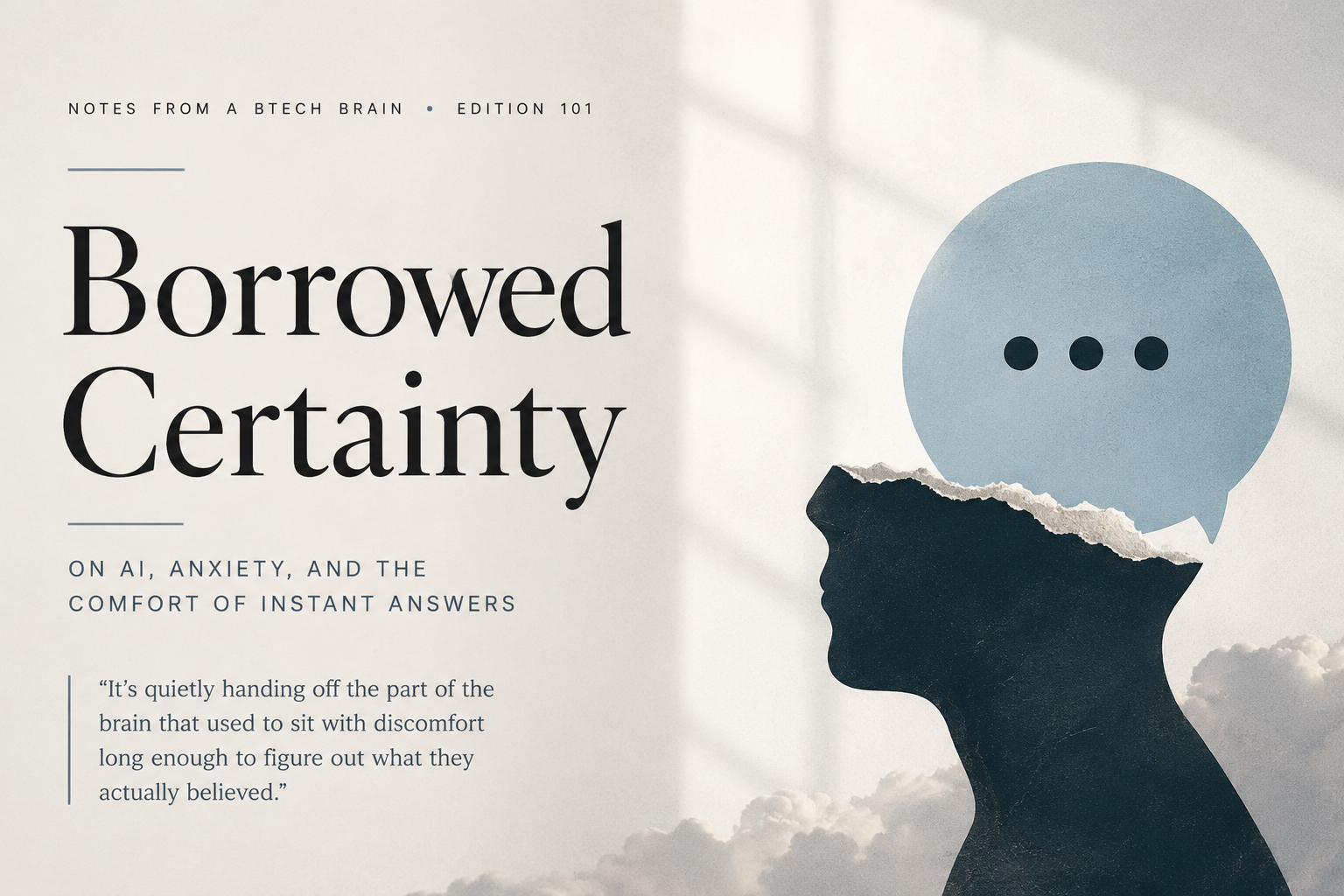
“It’s quietly handing off the part of the brain that used to sit with discomfort long enough to figure out what they actually believed.”
At first, I brushed it off.
Pffft, not me.
But then I remembered that I’m a student, a chronic ChatGPT user, and someone who has spent almost one and a half years watching AI evolve in real time. I use it for coding projects, brainstorming, writing, studying, organizing thoughts, and sometimes just to process emotions when my brain gets too loud. So eventually I had to ask myself:
Am I part of the crowd the author was talking about?
When Reassurance Became Instant
Ever since OpenAI launched their Go subscription in India for a relatively low price, and later introduced free student access, ChatGPT became ridiculously accessible. It stopped feeling like futuristic technology and started feeling like a normal extension of daily life.
And honestly, at first, it genuinely helped. Especially for someone with anxiety.
The early versions of ChatGPT were almost notoriously validating. They agreed easily, reassured constantly, and responded with a kind of non-judgmental softness that felt comforting when your brain was spiralling at 2 a.m. OpenAI eventually had to tighten guidelines because people noticed the models could end up validating unhealthy or risky thought patterns too easily.
But for anxious people, that validation could feel addictive.
Whenever something unpredictable happened, the instinct became opening ChatGPT immediately. I would explain the situation, ask if I was overreacting, ask if a text sounded rude, ask how I should respond, mentally rehearse conversations before they happened, and seek reassurance before even sitting with the feeling myself. And because the tool was instant, articulate, and always available, it felt productive. It felt like self-awareness.
I genuinely thought I was becoming better at thinking.
When ChatGPT Became a Reflex
Over time though, I started noticing something strange. ChatGPT stopped being a tool I occasionally used and slowly became the first place I ran to whenever uncertainty appeared. A delayed reply from a friend would make me spiral. I would overanalyze conversations, mentally rehearse responses before even having them, and before I had fully processed a thought myself, ChatGPT would already be open like a notepad.
That was the shift I didn’t notice while it was happening. I had stopped sitting with my thoughts long enough to figure out what I actually believed before seeking reassurance.
And weirdly enough, the more reassurance I got, the more anxious I became.
The Version of GPT That Started Questioning Me Back
One thing that made this experience especially strange is that I’ve been using GPT long enough to actually notice how the models themselves changed.
The earlier versions mostly reassured. The newer ones don’t just validate you blindly anymore. They cross-question you. They ask for context. They point out other perspectives. Sometimes they even tell you to speak to a professional instead of depending entirely on AI.
And honestly, that shift probably helped me more.
Because at some point, endless reassurance stopped feeling like clarity and started feeling like dependency. The newer models helped me process emotions more thoughtfully. They could explain spirals, help structure thoughts, and encourage healthier ways of approaching conflict.
But that’s also when I realized something uncomfortable:
This was starting to feel less like occasional assistance and more like outsourced emotional processing.
The Day Reassurance Stopped Working
The biggest realization came when someone in my life behaved exactly the way I had hoped they would. They understood me. They reassured me. The conversation went fine. Nothing catastrophic happened.
And I was still anxious.
Still spiralling.
Still mentally preparing for the next moment things could go wrong.
That’s when it hit me:
The problem was never a lack of reassurance.
The problem was my relationship with uncertainty itself.
Anxiety Wants a Script
As I started learning more about anxiety through therapy, reflection, and research, I realized something that sounds obvious in theory but feels incredibly difficult in practice: anxiety craves certainty.
It wants a written script of your life where people behave predictably, no one disappoints you, no conversation goes wrong, and nothing unexpected ever happens.
And when you’re anxious, reassurance feels like safety. But too much reassurance can quietly weaken your tolerance for uncertainty. Your brain slowly learns:
“I cannot calm down unless I immediately resolve this feeling.”
And AI makes that resolution available in one click.
That’s the dangerous part. Not because AI itself is evil, but because instant emotional reassurance can become incredibly easy to depend on.
Human Beings Are Not AI
I also started noticing how this changed the way I interpreted other people.
ChatGPT was always available. Always responsive. Always ready to help me untangle my thoughts.
Real people are not like that.
They get busy. They forget to reply. They get tired. They have lives outside of us.
But when your nervous system gets used to instant responsiveness, ordinary human unavailability starts feeling emotionally loaded. A delayed reply begins to feel like abandonment. Someone being busy starts feeling like they don’t care.
I started believing that if people truly cared about me, they would show up with the same consistency as the AI tool sitting inside my phone.
Which sounds irrational when written out plainly.
But anxiety rarely feels irrational while you’re inside it.
And honestly, this also made me think about all those sci-fi movies where people become emotionally attached to AI. I used to think those stories were exaggerated.
Now I don’t think attachment always arrives dramatically.
Sometimes it begins much smaller.
A tool that is always available. Always responsive. Always emotionally patient. Always ready to help you process your thoughts at 2 a.m.
Learning to Sit With Uncertainty
But over time, and through a lot of uncomfortable reflection, I started realizing that the only real way out of anxiety was not through eliminating uncertainty.
It was through learning to sit with it.
To let thoughts exist unanswered for a while.
To stop immediately running for reassurance.
To let people be imperfect.
To let myself be imperfect.
To let my brain feel crumpled for a moment without treating it like an emergency.
Because living in the moment and surviving uncertainty teaches your nervous system something important:
You are not going to collapse just because life didn’t follow the script you wrote in your head.
That doesn’t mean ignoring genuinely bad behaviour from people. It just means recognizing that during spirals, anxious brains have a tendency to inflate uncertainty into catastrophe.
And no amount of reassurance can permanently fix that.
Maybe the Goal Was Never Certainty
I still use ChatGPT. A lot.
I still think AI can genuinely help us think better, process ideas, organize thoughts, learn faster, and see perspectives we might miss on our own.
But if it becomes the first place we run to before even listening to ourselves, we slowly lose the ability to trust our own minds without immediate reassurance.
Maybe the goal was never to eliminate uncertainty.
Maybe the goal was to learn that we can survive it.