If you are competent and confident, interviews should be easy. At least, that is what I believed.
I write often. I speak well in group discussions. I am comfortable articulating ideas in public. So when I walked into a mock interview recently, I assumed it would go fine. I was not fully prepared, but it was a mock. The stakes were minimal. I expected myself to handle it.
I did not.
I froze at the simplest question possible. “Introduce yourself.”
What unsettled me was not the freeze itself, but the contradiction it exposed. I knew myself. I had skills and experiences to talk about. I even understood, in theory, how such an answer should be structured. Yet in that moment, I could not access any of it.
That was the point where the assumption broke.
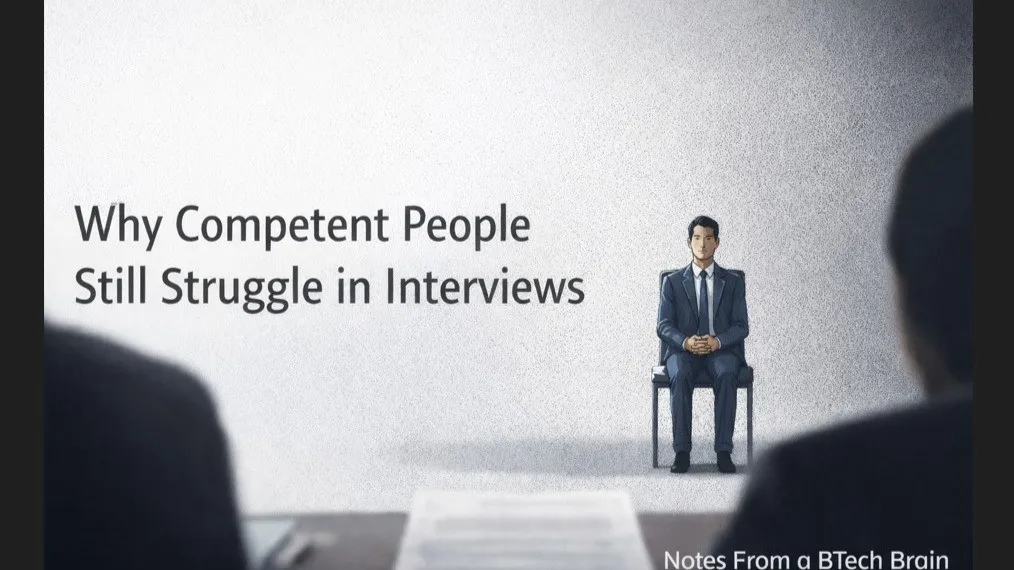
Interviews are often treated as a natural extension of confidence and competence. If you can speak well and think clearly, you are expected to perform well in them. But interviews are not a natural environment. They are highly artificial spaces with narrow expectations. You are required to speak about yourself within a specific structure, under evaluation, without external prompts to build off.
This creates a very different cognitive demand.
In public speaking or group discussions, ideas emerge through interaction. You respond, adapt, and expand in real time. Interviews remove that safety. The focus is entirely on you, and every pause carries weight. The task is not expression, but compression. You are expected to condense your identity, skills, and intent into a format that makes sense to someone who does not know you.
Pressure changes how access works.
Even when the stakes are low, the body responds to context. Being seated in front of a panel, knowing you are being assessed, and sensing silence after a question creates a level of internal pressure that cannot be reasoned away. You can tell yourself it is only a mock, but the nervous system reacts before logic has a chance to intervene.
This is why mock interviews exist.
They are not meant to test intelligence or confidence. They exist to expose how untrained many of us are for this particular format. Skill does not automatically translate into performance when the environment is unfamiliar. Structure has to be practiced. Retrieval has to be trained.
Years ago, my father bought a book titled How to Face Interviews. I never paid much attention to it. I assumed interviews were straightforward conversations where ability would naturally show. Only after freezing in a mock interview did I understand why such books exist at all. Interviews have always been treated as a distinct skill, separate from general competence.
An interview does not simply ask who you are. It asks whether you can present yourself clearly under constraint.
That is why preparation matters. Not as memorization, but as familiarity. Practicing how to introduce yourself, how to frame your experiences, and how to think aloud under pressure is what allows competence to surface when it counts.
The mock interview did not reveal a lack of ability. It revealed a lack of training for the environment that was testing it.
Once that distinction becomes clear, the problem feels far more solvable. You do not need to become a different person. You need to learn how to perform in a format that was never meant to be intuitive.