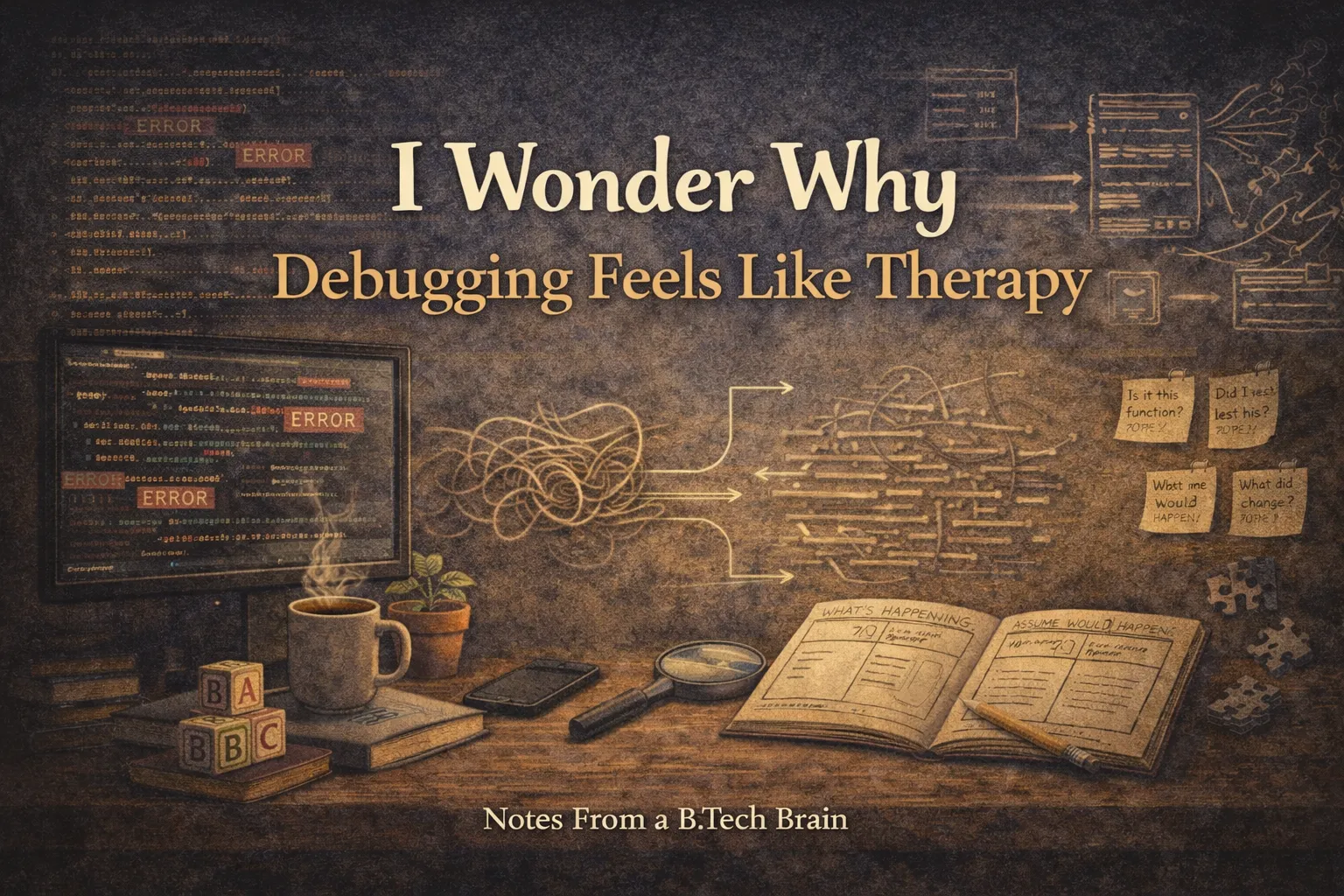
There is a certain kind of problem that does not respond to panic.
You cannot rush it. You cannot complain your way out of it. You cannot pretend it is not there and hope it resolves itself quietly in the background. These problems demand attention in a very specific way. Calm, honest, and a little uncomfortable.
Debugging turns out to be one of those problems.
Not because it is emotional, or healing in the way therapy is often described. But it forces a similar mindset. You cannot fix what you refuse to look at or make progress by reacting instead of reflecting.
That parallel only became obvious to me after enough hours spent staring at broken code.
The moment you realise staring harder will not fix it
There is a very specific moment every programmer knows.
You run the code. It breaks. You stare at the screen, hoping something will explain itself.
Nothing does.
At first, the instinct is emotional. Frustration. Panic. The urge to blame the compiler, the language, the laptop, your past self. Anything except the possibility that the problem might require actual thinking.
You cannot cry at broken code and expect it to heal.
And that is usually when debugging begins.
Debugging does not let you stay dramatic for long
Debugging is not glamorous.
It is slow. Occasionally humiliating. Most of the time, the bug turns out to be smaller than your reaction to it.
But what makes debugging interesting is that it does not reward emotional flailing. You can be upset. The code does not care. You can feel overwhelmed. The error message will still be there.
The only thing that moves the situation forward is reflection.
What is actually happening? What did I assume would happen? Where did those two diverge?
That shift from reaction to examination is not optional. Debugging forces it.
You cannot skip the uncomfortable questions
In debugging, you eventually have to confront your own assumptions.
You thought this variable had a value. You assumed this function behaved a certain way. You were confident this part was not the problem.
And then it is.
The process requires you to revisit decisions you made earlier and accept that they might have been wrong. Not maliciously wrong. Just incomplete.
That is uncomfortably similar to how reflection works in real life.
Growth rarely comes from dramatic moments. It comes from noticing patterns, questioning habits, and being willing to look at places you would rather skip.
Debugging rewards patience, not urgency
One of the strangest things about debugging is that rushing almost always makes it worse.
The more impatient you get, the more you break things. The more desperate you become, the less clearly you think.
Progress happens when you slow down enough to observe.
Print statements. Breakpoints. Stepping through logic line by line.
This is not efficiency in the usual sense. It is attentiveness.
And attentiveness, it turns out, solves more problems than force ever does.
Why the relief feels disproportionate
When the bug finally disappears, the relief is oddly deep.
Sometimes the fix is one character. A missing semicolon. A misplaced condition. Something objectively small.
But the relief does not come from the size of the fix. It comes from the process that led there.
You sat with the discomfort. You followed the logic. You understood the system better than you did before.
The code works again, but more importantly, you do.
Debugging is not therapy in the emotional sense.
It does not comfort you. It does not reassure you. It does not tell you that everything will be okay.
What it does is train a habit.
Look carefully. Question assumptions. Stay present with the problem instead of reacting to it.
And maybe that is why, despite how frustrating it can be, debugging feels strangely grounding. It reminds you that problems do not resolve themselves through panic.
They resolve when you are willing to look at them honestly, one step at a time.