As a kid, questions came without effort
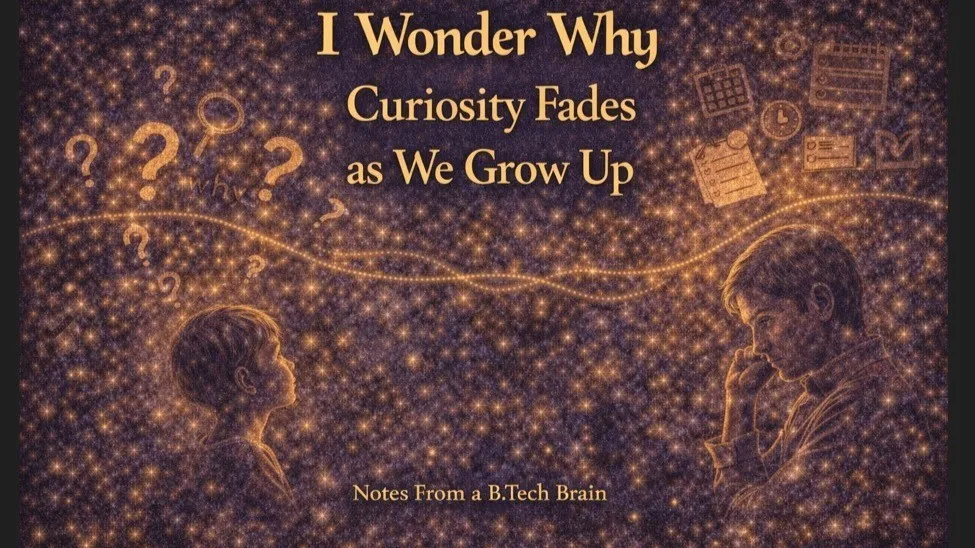
When you’re young, curiosity feels automatic.
You don’t ask questions because you’re trying to learn something useful. You ask because the question itself feels alive. Why is the sky that colour. Why does this work like that. Why not do it another way.
No one needs to convince you that wondering is allowed. It just happens.
Somewhere along the way, that changes.
Answers start to matter more than questions
As we grow up, the environment shifts.
Questions slowly turn into tasks. Curiosity gets redirected toward outcomes. There’s usually a reason you’re asking something now. An exam. A deadline. A problem that needs fixing.
Wondering without a clear purpose starts to feel inefficient.
You’re rewarded for knowing. Not for lingering.
So the brain adapts. It learns to move quickly toward answers and skip the parts where nothing is immediately resolved.
Familiarity shrinks the world
A lot of things stop feeling new.
You’ve seen similar situations before. You’ve heard versions of the same explanation. Patterns repeat. Surprises become rarer.
When the brain thinks it already understands something, it stops poking at it. Curiosity doesn’t disappear. It just gets quieter when novelty drops.
Life starts to feel smaller, not because it is, but because it feels mapped.
Responsibility crowds the mental space
Curiosity needs room.
It needs time without urgency. Attention without pressure. Space to wander without immediately justifying itself.
Adult life doesn’t offer much of that by default.
There’s always something that needs doing. Something unfinished. Something more important than sitting with a question that leads nowhere obvious.
So curiosity gets postponed. And then postponed again.
Wonder becomes optional instead of necessary
As children, curiosity is how we orient ourselves.
As adults, it becomes something extra. Something you engage in if you have the energy left over.
That shift matters.
When curiosity becomes optional, it’s the first thing to go when life gets busy. It doesn’t fight for attention the way obligations do.
I don’t think curiosity fades because we grow less intelligent or less imaginative.
I think it fades because the world slowly trains us to move past uncertainty instead of sitting with it.
The questions don’t vanish. They just wait quietly for moments when we feel safe enough, unhurried enough, to notice them again.
And maybe curiosity never really leaves.
Maybe it just stops interrupting us, until we learn how to invite it back.