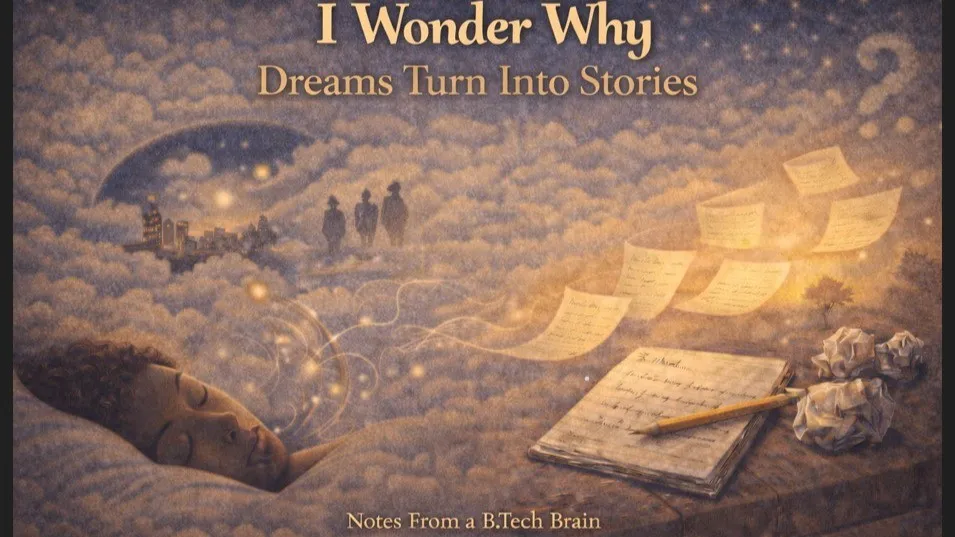
While I’m dreaming, nothing feels strange.
Scenes jump. People change. Time folds in on itself. Places merge. I accept all of it without protest. The dream doesn’t ask to make sense while it’s happening.
It’s only after I wake up that something interesting happens.
I try to tell the dream to myself, or to someone else, and suddenly it becomes a story. There’s a beginning now. A middle. Some loose sense of cause and effect. I stitch pieces together as if they were always meant to go that way.
But I know they weren’t.
The dream itself isn’t linear
When I pay closer attention, dreams don’t actually behave like stories at all.
They’re more like fragments. Moments. Emotional snapshots glued together without transitions. One scene dissolves into another without explanation. Characters appear without backstories. Settings shift without warning.
There’s no clear plot while it’s happening. Just movement.
The logic only shows up later, when I’m awake and trying to remember it.
Waking up turns memory into narrative
The moment consciousness comes back online, the brain starts doing what it’s very good at.
It organises.
We’re used to understanding life through sequences. This happened, then that happened, therefore this mattered. So when we recall a dream, the brain applies the same structure automatically.
We smooth over gaps. We invent connections. We turn a pile of impressions into something tellable.
The story isn’t the dream. The story is what happens after.
Dreams seem emotional before they are logical
What stays with me longest from a dream is rarely the sequence of events.
It’s the feeling.
Fear without a clear source. Relief without a reason. A sense of urgency that doesn’t point anywhere specific. Those emotions linger even when the details fade.
That makes me think dreams are built around emotional states first, not narratives. The brain is processing something, but not in sentences or plots. It’s closer to mood than meaning.
The story only appears when we go looking for one.
Why the brain accepts nonsense while dreaming
Another strange thing is how little resistance there is.
In dreams, I don’t question obvious inconsistencies. A person can be two people at once. A room can belong to three places. Time can skip entire years and I won’t notice.
The part of the brain that checks for coherence seems quieter during sleep. Without that internal editor, experiences don’t need to justify themselves.
They just pass through.
It’s only when I wake up that my brain asks for reasons.
I don’t think dreams are trying to tell stories.
I think they’re doing something else entirely, and stories are just the closest language we have for describing what they leave behind.
When we remember dreams, we’re not replaying them. We’re translating them. Turning something raw and nonverbal into something that fits how we usually understand the world.
Maybe that’s why dreams feel slippery when we try to explain them. They weren’t meant to be narrated. They were meant to be experienced and then partially lost.
And maybe the strange comfort of dreams comes from that. For a few hours, the brain gets to think without needing to make sense.