I didn’t notice them as math at first
The first time I really saw a fractal, I didn’t call it that.
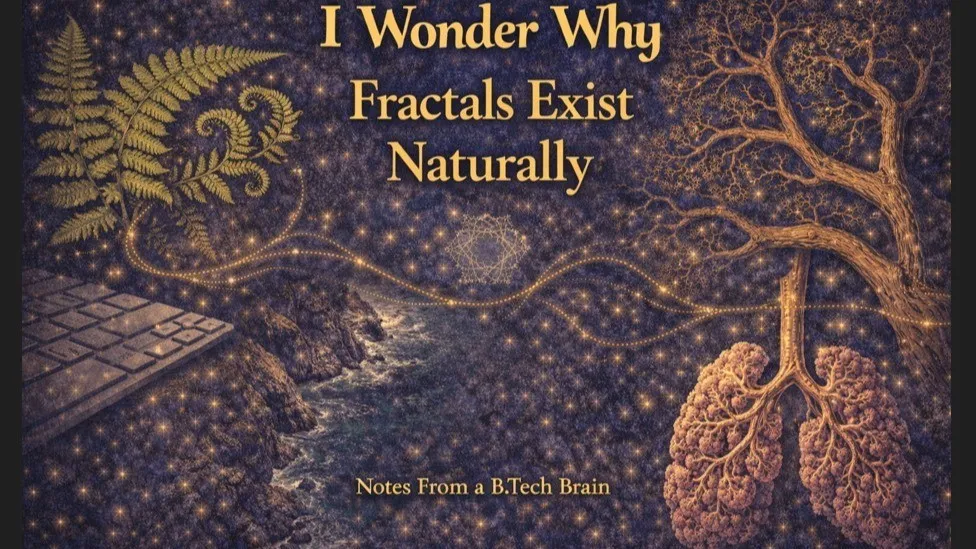
It was a leaf. Or a fern. Or maybe the edge of a coastline on a map. Something that looked detailed up close, and somehow stayed detailed even when I stepped back.
The shape repeated, but not exactly. Smaller versions of the same idea kept appearing, nested inside each other.
It didn’t feel designed. It felt… inevitable.
Zooming in doesn’t simplify things
Most objects get simpler when you zoom in.
A wall becomes paint. Paint becomes texture. Texture eventually becomes nothing interesting at all.
Fractals do the opposite.
You zoom in, and the complexity doesn’t disappear. It just rearranges itself. The same roughness. The same branching. The same uneven edges, just scaled down.
That’s what makes them unsettling and beautiful at the same time. There’s no final, clean layer where the mess stops.
This showed up right after I wrote about patterns
This piece grew out of thinking more about patterns after a thoughtful comment pointing me toward fractals in nature.
If the brain keeps searching for patterns, fractals are what happen when patterns refuse to stay simple. They repeat, but not neatly. They obey rules, but don’t resolve into clean shapes.
They’re patterns that don’t end.
Nature seems to reuse instructions instead of shapes
I don’t think nature is trying to draw pretty patterns.
It’s trying to grow.
And growth works better when the same basic rule can be applied again and again. Branch here. Split there. Repeat.
A tree doesn’t need a new plan for every twig. A lung doesn’t need a new blueprint for every airway. The same instruction, applied repeatedly, creates complexity without needing constant redesign.
Fractals feel less like shapes and more like habits.
Efficiency hides inside the mess
There’s a practical side to this too.
Fractal-like structures maximise surface area. More edges. More contact. More exposure.
That’s useful for leaves catching sunlight, lungs absorbing oxygen, roots reaching through soil. What looks chaotic is often doing something very specific.
The mess has a job.
Which makes me think that our idea of “clean design” is very human. Nature seems comfortable with forms that look unfinished, as long as they work.
Why they don’t feel random
Even though fractals look irregular, they don’t feel accidental.
There’s a consistency to them. A rhythm. The repetition gives the brain something to latch onto, even if the exact details never repeat.
That might be why fractals feel calming to look at. They’re complex without being unpredictable. Ordered without being rigid.
The brain recognises the rule, even if it can’t trace every outcome.
I don’t think fractals exist because nature likes patterns.
I think they exist because repeating simple processes over time creates them whether you want them or not.
Growth leaves traces. Processes echo themselves. The same action, applied at different scales, starts resembling itself.
Fractals aren’t decorations scattered across the natural world. They’re evidence.
Evidence that complexity doesn’t always come from complexity. Sometimes it comes from doing the same simple thing, patiently, over and over again.
And maybe that’s why, once you start noticing patterns, fractals are impossible to unsee.