The first time I met it, it felt bigger than it needed to be
I remember learning about the golden ratio in school as if it were a secret.
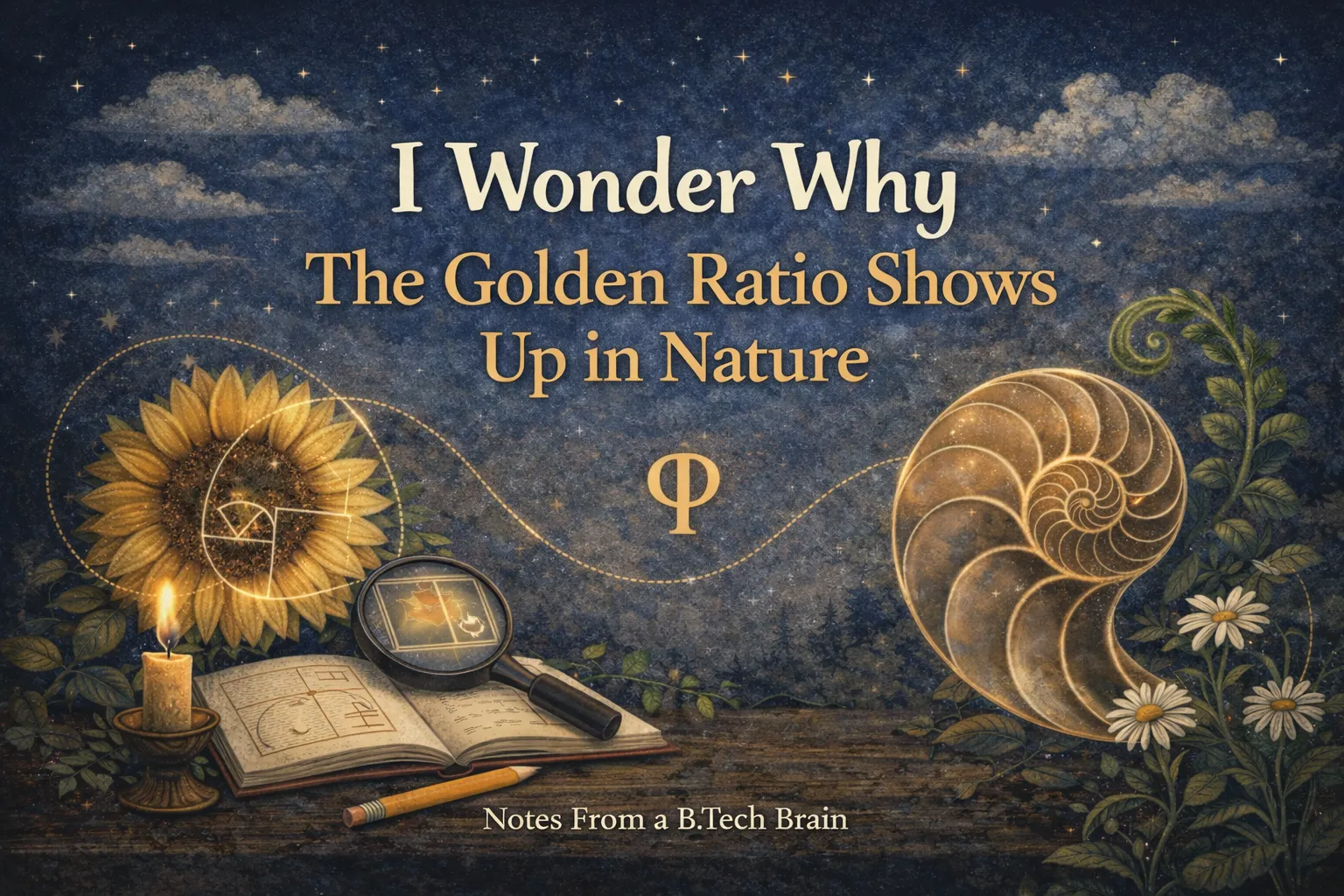
It had a symbol, φ. It had a value, roughly 1.618. And it came with this quiet implication that it mattered more than other numbers.
It was presented as something special. Elegant. Almost sacred.
At that age, I did not really ask why. I just accepted that this number was important, memorised where it showed up, and moved on. Only much later did I start wondering what made this particular ratio so fascinating in the first place, and whether nature was actually following it or if we were just very eager to see it everywhere.
What the golden ratio actually is
Stripped of the mystery, the golden ratio is a relationship between two quantities.
If you divide something into two parts so that the ratio of the whole to the larger part is the same as the ratio of the larger part to the smaller, you get φ.
That is it. No symbolism required.
What makes it interesting is that this ratio has a strange mathematical property. It shows up naturally when you work with certain equations, and it emerges cleanly from sequences like the Fibonacci sequence. The math itself is internally consistent. The number is not arbitrary.
So when people say φ is special, they are not completely wrong. It is mathematically distinctive.
The mistake happens when that distinctiveness turns into exaggeration.
Why it appears in nature sometimes
Nature does not follow formulas. But it does optimise.
Plants, for example, grow under constraints. Leaves need sunlight. Seeds need space. Petals need to arrange themselves without blocking one another.
In some of these growth processes, arrangements that approximate the golden ratio turn out to be efficient. They allow better packing, better exposure, and less overlap.
That is why you see spiral patterns in sunflowers or pinecones that resemble Fibonacci numbers. Not because plants know math, but because certain ratios help them use space well.
The golden ratio is not a rule nature obeys. It is a pattern that can emerge when efficiency and growth collide.
Why it is not actually everywhere
Here is the part that usually gets skipped.
The golden ratio does not appear universally. Many natural structures do not follow it at all. Some resemble it loosely. Others do not come close.
What complicates things is that humans are very good at pattern-matching. If you expect to see φ, you will often find an approximation of it, especially if you allow flexibility.
A rectangle that is close to 1.6 to 1 can suddenly become “golden.” A spiral that roughly curves can be declared Fibonacci-like.
This does not mean people are lying. It means we are generous interpreters when we want a pattern to be meaningful.
The golden ratio exists in nature sometimes. Our enthusiasm does the rest.
Why it still feels beautiful
Even when we remove the exaggeration, the fascination does not disappear.
The golden ratio sits in a space between symmetry and imbalance. It is not perfectly even. It is not chaotic either. That slight unevenness is part of what makes it feel organic.
Perfect symmetry can feel rigid. Total randomness feels noisy. Ratios like φ live in between, where balance exists without looking manufactured.
The brain seems to like that middle ground. It processes it easily, but it does not get bored.
So when we call the golden ratio beautiful, we are not responding to the number itself. We are responding to what it represents. Order that still feels alive.
Why this changed how I think about it
I no longer think of the golden ratio as a hidden code written into the universe.
I think of it as a meeting point.
A place where math produces something elegant, where nature sometimes aligns with efficiency, and where human perception fills in the rest with meaning.
It is not a divine fingerprint. It does not need to be.
It is interesting because it sits at the intersection of structure and growth, logic and aesthetics. And maybe that is enough.
The golden ratio does not explain beauty. But it helps explain why certain kinds of balance keep catching our eye.
And once you see it that way, the fascination feels quieter, but more honest.