I didn’t think they were special at first
When I first learned about prime numbers, they felt… procedural.
A number that can only be divided by one and itself. There was a rule. There was a test. You either passed it or you didn’t. End of story.
I memorised a few. Two. Three. Five. Seven. Eleven. After that, I stopped caring.
It took a while before I realised that primes keep showing up long after you’ve learned how to define them.
They refuse to follow a pattern we can rely on
Most numbers behave politely.
Even numbers line up perfectly. Multiples repeat themselves. Sequences settle into rhythms you can predict once you know the rule.
Prime numbers don’t do that.
They show up irregularly. Sometimes close together. Sometimes far apart. Sometimes they surprise you by appearing where you didn’t expect one at all.
You can check whether a number is prime. That part is mechanical. But predicting where the next one will be feels different.
There’s no simple rhythm to lean on.
They feel discovered, not constructed
What makes primes strange is that we don’t get to invent them.
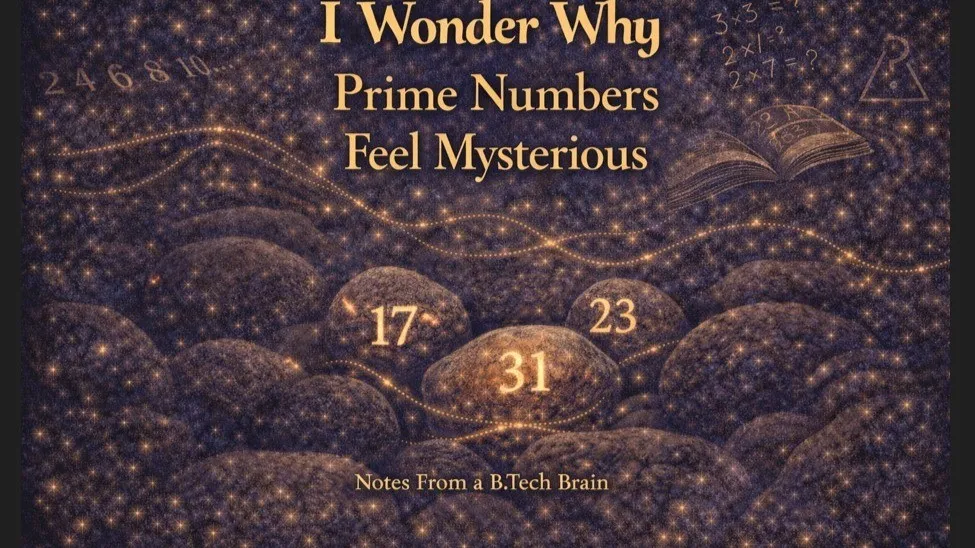
We can define what a prime number is, but we don’t get to decide where they appear. They already exist inside the number system, scattered in their own way.
When you find one, it feels less like building something and more like uncovering it.
That might be why primes feel more like objects than ideas. Like stones hidden in a riverbed. You don’t place them. You notice them when the water clears just enough.
The rules don’t get simpler as numbers get bigger
With many mathematical concepts, complexity smooths out at scale.
With primes, it doesn’t.
The gaps between them grow. Then shrink. Then grow again. There’s structure there, but it doesn’t collapse into something tidy. The further you go, the less intuitive things feel.
Even mathematicians don’t talk about primes with full confidence. There are patterns, tendencies, estimates. But also a lot of uncertainty.
That tension between knowing and not knowing never really disappears.
They sit at the foundation without drawing attention to themselves
Prime numbers quietly underpin a lot of things.
They’re the building blocks of other numbers. Every composite number can be broken down into primes. Everything else depends on them, whether it’s obvious or not.
And yet, primes themselves don’t combine cleanly. They don’t explain each other. They just exist, stubbornly indivisible.
That contrast is hard to ignore. They’re essential, but solitary.
I don’t think prime numbers feel mysterious because they’re rare or difficult to define.
They feel mysterious because they resist being tamed.
You can study them for years and still feel like you’re circling something that won’t quite come into focus. They follow rules, but not the kind that make you feel in control.
Maybe that’s why primes keep drawing attention back to themselves.
In a system built on logic and certainty, they’re a reminder that even the most orderly worlds still have corners that don’t fully open up.