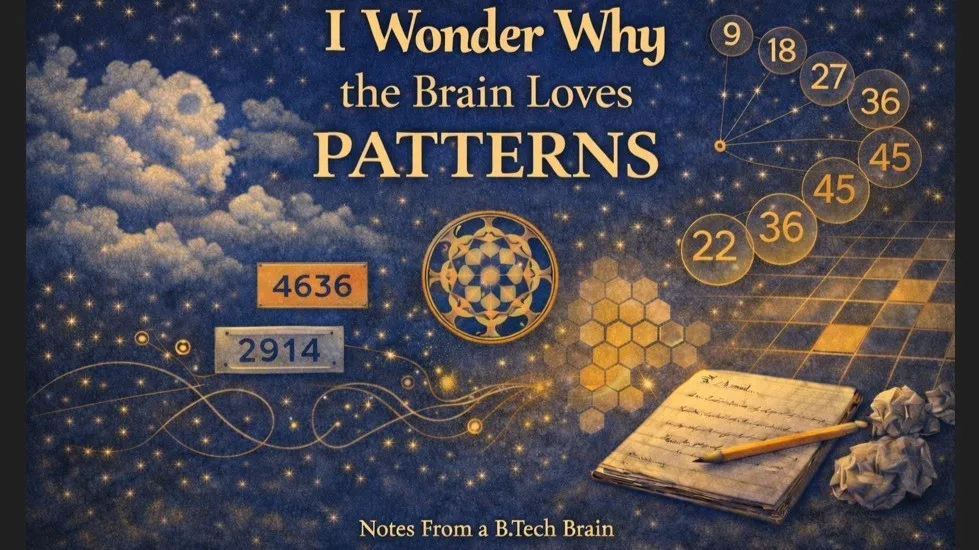
I’ll be looking at something ordinary. Clouds. Tiles on a floor. A series of numbers. And suddenly my brain latches on.
That looks like a face. That repeats. That almost lines up.
Once the pattern appears, it’s hard to stop seeing it. Even when I know it doesn’t really mean anything, my attention sticks. The mind feels oddly satisfied, like it has done a small but important job.
What confuses me is how automatic this is. I don’t decide to look for patterns. They announce themselves.
I do this thing with car number plates
I notice it most when I’m on the road.
If I’m sitting in traffic or just zoning out in a car, my eyes drift to number plates. Not the whole thing, just the last four digits. And without really planning to, I start testing them.
First for 5, obviously. That one’s too easy not to check.
Then 3, which is honestly my favourite. I just start adding the digits together. There’s something weirdly satisfying about it. I don’t even care that much whether it works. I just like doing the addition. It feels neat. Contained. Like the numbers are cooperating for once.
If I’m especially free, and the number looks kind of pretty, I go for 7.
That’s when I use that rule where you remove the last digit, double it, and subtract it from the remaining number. If what you’re left with is zero or divisible by 7, the whole number works.
Half the time I don’t even finish checking. I just enjoy running the rule.
Sometimes I catch myself doing all this and wonder why I’m spending mental energy on something so useless. There’s no reward. No outcome. No reason to know whether a random car’s number plate is divisible by anything at all.
And yet, my brain seems very invested.
When the number works out cleanly, there’s a small, quiet satisfaction. When it doesn’t, I move on to the next one. No disappointment. Just continuation.
It feels like a game I never consciously agreed to play.
Seeing patterns feels good, even when they’re useless
That’s the part I keep coming back to.
Most of the patterns I notice don’t help me in any real way. Faces in clouds don’t change the weather. Divisible numbers on cars don’t improve my day. Coincidences rarely mean what we want them to mean.
And yet, the brain reacts as if something valuable has been found.
There’s a tiny sense of order when things line up. A momentary calm when chaos looks structured. Even false patterns feel better than none at all.
It makes me wonder if the brain prefers a weak explanation over no explanation.
Pattern-seeking seems older than reasoning
From what I understand, pattern recognition is one of the brain’s earliest skills.
Before language, before abstract thinking, before long explanations, there was noticing. This thing follows that thing. This sound usually comes before that movement. This shape often means danger. That one doesn’t.
Patterns made the world predictable enough to survive in.
That instinct didn’t disappear when life got safer or more complex. It stayed. It just started showing up in quieter places. Numbers. Shapes. Habits. Thoughts.
Why randomness makes us uncomfortable
True randomness is hard to sit with.
When events feel disconnected, the brain starts reaching. Looking for causes. Drawing lines between points that may not belong together.
That’s why we replay conversations, searching for hidden meanings. Why we assign significance to timing. Why silence feels heavier when we don’t know what it means.
Patterns offer a sense of control. Even imagined ones.
They make the world feel less arbitrary, even if they aren’t strictly accurate.
Patterns show up everywhere once you expect them
The more I think about patterns, the more I notice how expectation shapes perception.
Once you learn a concept, you start seeing it everywhere. Once a number feels special, it keeps appearing. Once symmetry is pointed out, imbalance feels louder.
The pattern didn’t suddenly increase. Attention did.
That makes me cautious about how much meaning I assign to what I notice. The brain is very good at convincing itself that discovery has happened, even when it’s just familiarity catching up.
When pattern-seeking turns against us
The same habit that helps us learn can also trap us.
We see trends where there are none. We assume intent where there was only chance. We cling to explanations because uncertainty feels worse than being wrong.
The brain doesn’t always ask whether something is true. It often asks whether it makes enough sense to move on.
And sometimes, that’s enough.
I don’t think the brain loves patterns because patterns are beautiful or profound on their own.
I think it loves them because patterns promise stability.
They suggest that the world is not completely random, that things connect, that understanding is possible if we look closely enough.
Even when that promise turns out to be exaggerated, the comfort remains.
Maybe pattern-seeking isn’t about finding truth at all. Maybe it’s about finding something solid to hold onto, even briefly, in a world that rarely stays still.
And maybe that’s why my brain keeps checking number plates, long after it has learned there’s nothing at stake.