It usually starts with mild frustration.
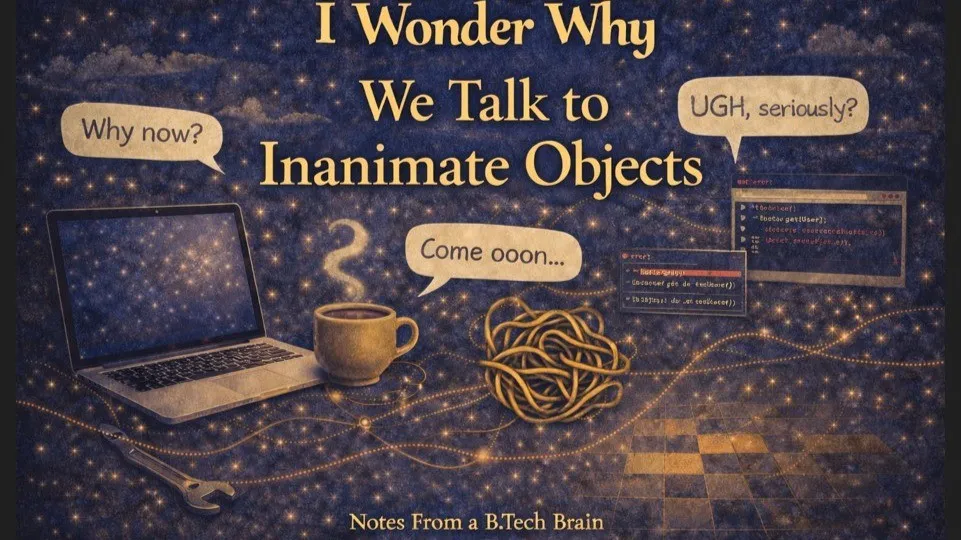
My laptop freezes. The code refuses to run. The page takes too long to load. And without thinking, I say something out loud. Not loudly. Not dramatically. Just a quiet, “Come on,” or “Why are you doing this now?”
I’m not expecting a response. I know that.
And yet, the words come out as if there’s someone on the other side who could choose to cooperate.
It’s not conversation. It’s negotiation
When I talk to my laptop or my code, I’m not really talking to it.
I’m talking around the problem.
The words aren’t meant to be heard. They’re meant to mark a moment. To signal that something has gone wrong and that I’m now engaged with it. Saying it out loud makes the problem feel more real, more contained.
Like I’ve acknowledged it properly.
Sometimes the tone is pleading. Sometimes it’s annoyed. Sometimes it’s weirdly polite. But the goal is always the same. I want the thing to work again.
Giving objects a voice makes them easier to deal with
There’s something strangely comforting about treating an object like it has intentions.
If the code is “being annoying,” then the failure feels less personal. It’s not that I don’t understand something. It’s that the thing is misbehaving. The blame shifts just enough to take the edge off.
Talking to it externalises the frustration. It moves the problem out of my head and into the space between me and the object.
I’m no longer stuck inside the issue. I’m standing across from it.
We do this most when we’re alone
I’ve noticed that I do this far more when no one else is around.
In public, I stay quiet. Internally annoyed, maybe, but silent. Alone, the commentary comes out freely. It’s not performative. It’s not meant to be heard.
That makes me think it’s not about communication at all. It’s about regulation.
Saying something gives the feeling somewhere to go.
It’s easier than sitting in silence
When something breaks, there’s a small pause where nothing happens.
No progress. No clarity. Just waiting.
Talking fills that gap.
Even a single sentence breaks the stillness. It gives the moment a shape. Instead of staring quietly at a stuck screen, I’m now doing something, even if that something is just talking to it.
The object doesn’t change. But the experience does.
I don’t think we talk to inanimate objects because we’re confused about what they are.
I think we do it because language is one of the fastest ways we know how to respond when something interrupts our sense of flow.
The laptop doesn’t listen. The code doesn’t care.
But saying something anyway makes the moment feel less frozen.