Can a world like Pandora even exist?
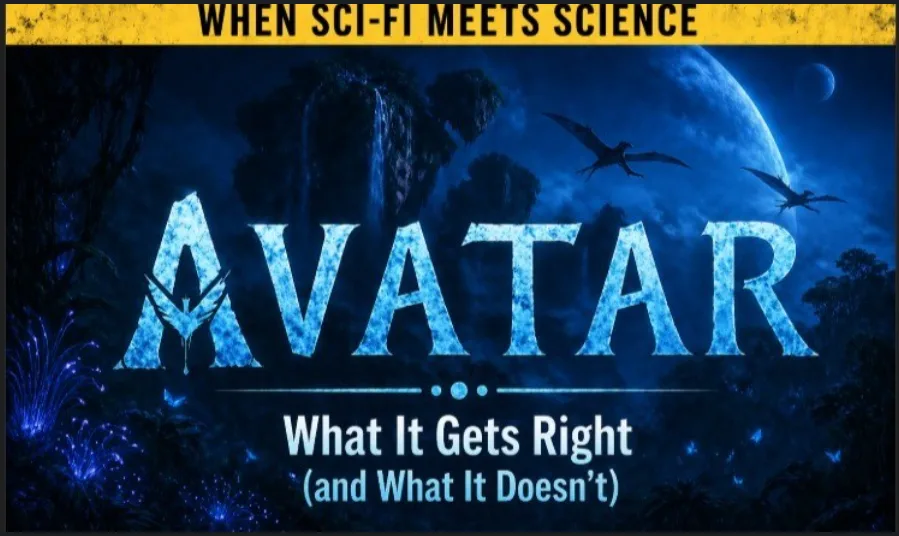
At first glance, Pandora feels too perfect to be real.
Floating mountains. Glowing forests. Creatures that seem designed rather than evolved. Everything looks connected, almost intentionally.
It feels less like a planet and more like a system that was planned.
But strip away the visual exaggeration, and the core idea becomes more reasonable. The universe is vast, and planets with different conditions, atmospheres, and ecosystems are not just possible, they are expected.
We already know of exoplanets with extreme environments. Some are larger than Earth, some orbit multiple stars, some may even have conditions that could support life.
So a planet like Pandora is unlikely in its exact form.
But a planet with unfamiliar biology, different environmental rules, and complex ecosystems is not unrealistic.
The idea of a connected ecosystem
One of the most striking ideas in Avatar is that everything on Pandora is connected.
Not metaphorically.
Physically.
Through roots, through neural-like structures, through something that allows information to move between living organisms.
This idea sounds fictional, but it has a real parallel.
On Earth, forests are already connected in ways we didn’t fully understand until recently. Through underground fungal networks, often called the “wood wide web,” trees can exchange nutrients, send signals, and even respond to environmental stress collectively.
Plants are not isolated.
They are part of systems.
Avatar takes this idea and scales it up.
Instead of chemical signals and slow exchanges, it imagines a fast, structured, almost nervous system-like connection across an entire ecosystem.
That part is exaggerated.
But the foundation is real.
Eywa and the idea of a planetary mind
The film introduces Eywa as a kind of guiding force, something that connects and balances all life on the planet.
Scientifically, this is where things move into speculation.
There is no evidence that ecosystems can form a unified consciousness or a central “mind.” Systems can be interconnected, responsive, and adaptive, but that is not the same as awareness.
However, the idea does connect loosely to concepts like the Gaia hypothesis, which suggests that Earth functions as a self-regulating system where living organisms and the environment interact to maintain balance.
That doesn’t mean Earth is conscious.
But it does mean systems can behave in coordinated ways without central control.
Avatar turns that coordination into something closer to intention.
Neural connections between living beings
The direct neural linking shown in the film is one of its most distinctive ideas.
Characters connect through physical interfaces, linking their nervous systems with animals, plants, and even each other. This allows for immediate understanding, control, and shared experience.
In reality, we are only beginning to explore neural interfaces.
Brain-computer interfaces can:
- read limited neural signals
- send basic feedback
- assist in controlling devices
But connecting two fully independent nervous systems in a seamless, meaningful way is far beyond current science.
The complexity of the brain alone makes this extremely difficult.
Linking multiple species with entirely different biology makes it even less feasible.
Biology that feels designed
The creatures and plants in Avatar often feel intentional, as if they were built to fit together perfectly.
Real ecosystems don’t work like that.
They evolve.
Through randomness, adaptation, and survival pressures over long periods of time. This creates complexity, but not perfection.
That said, evolution can produce surprisingly efficient systems.
Symbiotic relationships exist. Species depend on each other. Environments shape behavior and form.
So while Pandora looks too coordinated to be realistic, the idea of deeply interconnected life isn’t.
It’s just less neat in reality.
Where the film stretches the most
The biggest leap is the speed and clarity of connection.
Information in real ecosystems moves slowly. Signals are chemical, electrical, or behavioral, and they take time.
Avatar presents instant understanding.
Instant bonding.
Instant transfer of control.
That level of immediacy doesn’t exist in known biological systems.
It’s a narrative choice.
Not a scientific one.
Why it still feels believable
Even with its exaggerations, Avatar works because it builds on ideas that already exist.
Ecosystems are connected. Life adapts to its environment. Systems can respond collectively without central control.
The film just amplifies these ideas until they become visible.
Until they feel intentional.
What the film gets right overall
Avatar doesn’t predict how life on another planet would look.
It explores how different it could be.
Not just in appearance, but in structure, connection, and interaction.
And while Eywa, neural bonding, and perfect harmony are fictional, the underlying idea isn’t.
Life doesn’t have to work the way it does on Earth.