When reality becomes questionable
Most of the time, reality feels stable.
You see something, you trust it. You experience something, you assume it’s real. There isn’t much reason to question it, because everything appears consistent.
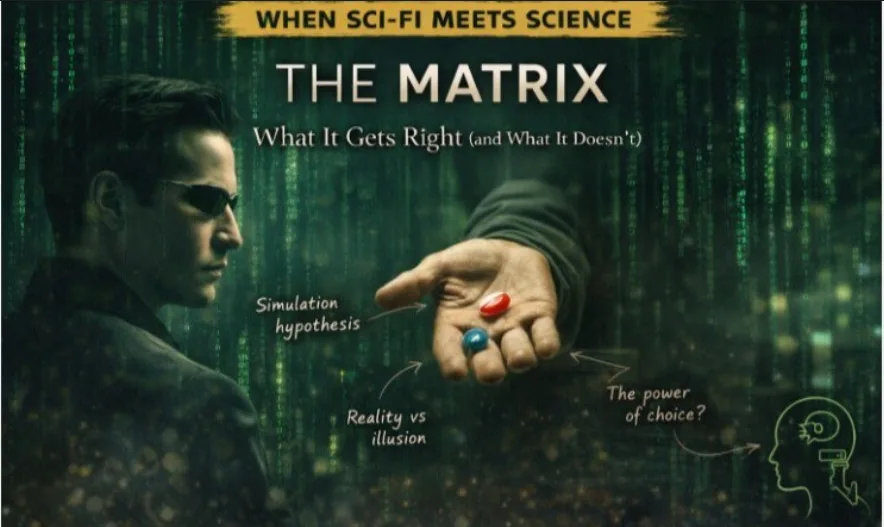
The Matrix takes that assumption and removes it completely.
It suggests that what we experience as reality could be a simulation. Not partially, not occasionally, but entirely constructed.
That idea sounds extreme.
But it isn’t entirely disconnected from real discussions.
The idea of simulation
The core concept of The Matrix is that human consciousness is connected to a simulated environment while the physical body exists somewhere else.
In theory, this relates to what we already understand about perception.
We don’t experience the world directly.
Our brain receives signals through the senses, processes them, and constructs what we perceive as reality.
So in a way, our experience is already a “model” built by the brain.
The film extends this idea.
Instead of signals coming from the real world, they come from an artificial system.
Is a full simulation possible?
This is where things become more speculative.
To simulate reality at the level shown in the film, a system would need to:
- replicate physical environments
- simulate sensory input perfectly
- maintain consistency across millions of individuals
That requires an enormous amount of computational power.
Far beyond anything we currently have.
There are real discussions, like the simulation hypothesis, which suggest that advanced civilizations might be capable of creating such simulations.
But this is philosophical, not proven science.
We have no evidence that we are inside one.
The brain as an interface
The film shows humans connected to the simulation through direct neural links.
This part is partially grounded.
We already have early versions of brain-computer interfaces. These systems can:
- interpret neural signals
- control external devices
- send limited feedback to the brain
But they are extremely basic compared to what the film shows.
We cannot:
- upload full experiences
- replace all sensory input
- or create entire virtual realities inside the brain
That level of control over the brain doesn’t exist yet.
Downloading skills instantly
One of the most iconic ideas in The Matrix is the ability to “download” skills directly into the brain.
Learning without practice.
Knowledge without time.
This is not currently possible.
Skills are not just information. They involve:
- neural pathways
- muscle memory
- repeated reinforcement
Even if we could transfer data to the brain, turning that into usable skill would require physical and cognitive adaptation.
You can’t become an expert instantly just by receiving information.
Unfortunately.
Where the film stretches logic
Beyond the simulation itself, the film introduces ideas like:
- bending physical laws inside the simulation
- controlling outcomes through belief
- breaking constraints by “realising the truth”
These are narrative choices.
They make sense within the film’s internal rules, but they don’t reflect real scientific principles.
Even in a simulated environment, rules would still exist.
They might be different.
But they wouldn’t disappear.
Why the idea still feels compelling
Even with its exaggerations, The Matrix holds onto something real.
The idea that perception is constructed.
We don’t question reality because it feels consistent, not because we have verified it.
And that opens the door to the possibility, however unlikely, that what we experience could be manipulated.
Not necessarily at the scale of the film.
But in smaller, more immediate ways.
Science vs philosophy
The Matrix sits at the edge of science and philosophy.
The technology it shows isn’t realistic with current knowledge.
But the question it raises is still discussed.
What if reality isn’t what we think it is?
Science can’t fully answer that.
At least, not yet.
What the film leaves you with
The most interesting part of The Matrix isn’t whether we are living in a simulation.
It’s how easily we accept reality as it appears.
And how difficult it is to question something that feels completely real while you’re inside it.
(Next: a quieter, slower film that asks a different version of the same question — not whether reality is simulated, but what it means to be human inside it.)