When the line between human and artificial starts to blur
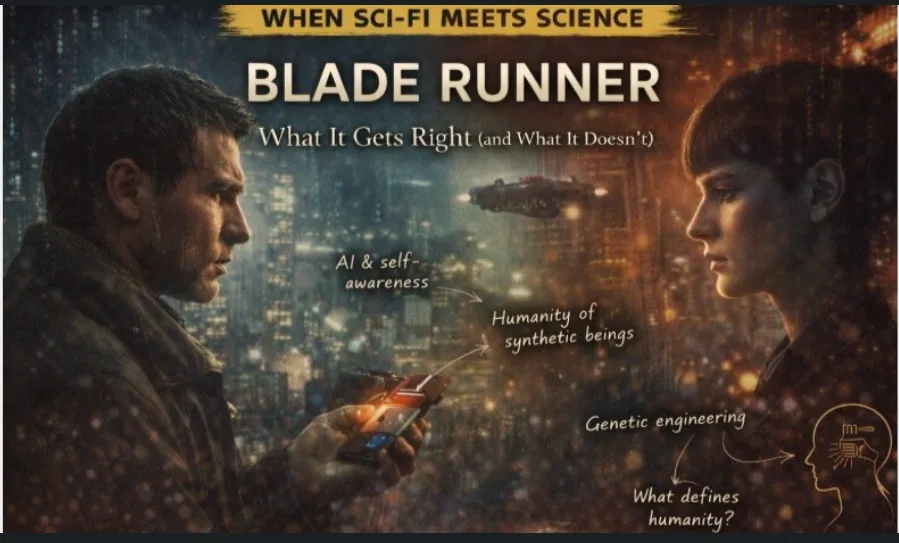
Most science fiction treats the difference between humans and machines as something obvious. One is organic, emotional, unpredictable. The other is constructed, controlled, and clearly separate. Blade Runner 2049 quietly removes that clarity. The artificial humans in the film, known as replicants, don’t just look human. They behave in ways that feel deeply human. They form memories, respond emotionally, and develop a sense of identity that doesn’t immediately feel artificial. This is where the film becomes less about technology and more about definition. Not what is built, but what counts as real.
The idea of engineered humans
The concept of replicants is loosely connected to real-world discussions around genetic engineering and synthetic biology. Scientists today can already modify genes, grow tissues in labs, and experiment with creating biological systems outside the human body. However, the idea of fully engineered humans, designed from scratch with controlled intelligence, memory, and behavior, is still far beyond our current capabilities. Creating a body is one problem. Creating a fully functional mind, with awareness and identity, is an entirely different one. We don’t yet understand consciousness well enough to replicate it, even if we could build the biology.
Memory as a foundation of identity
One of the most interesting ideas in the film is the use of artificial memories. Replicants are given memories to stabilize their behavior, to make them more controllable and emotionally grounded. This idea has some psychological basis. Human identity is deeply tied to memory. The way we understand ourselves depends on what we remember, how we interpret those memories, and how they connect over time. If you could alter someone’s memories, you could influence how they see themselves. However, the film takes this further by suggesting that entirely fabricated memories could function exactly like real ones. While false memories can exist, and people can believe in experiences that never happened, constructing a full, stable identity from artificial memories alone is still not something we know how to do.
Can emotions be engineered?
The replicants in the film don’t just act logically. They feel. They form attachments, experience conflict, and struggle with purpose. This raises a difficult question: are these emotions real, or are they just convincing simulations? In current science, we don’t have a way to engineer genuine emotional experience in artificial systems. AI can mimic emotional responses, but it doesn’t experience them. Even in biological terms, emotions are tied to complex chemical and neurological processes that we don’t fully understand. So while the film presents emotional replicants as a given, the science behind creating true emotional experience remains unclear.
Where the film stretches reality
The biggest leap the film makes is assuming that consciousness can be designed and replicated with precision. The idea that we could build beings that not only think, but also develop identity, question their existence, and form meaningful connections, is still speculative. We don’t know what creates consciousness, and without that understanding, we cannot recreate it. The film also assumes a level of control over biology and cognition that doesn’t exist yet. Designing intelligence is one challenge. Designing self-awareness is another entirely.
Why it still feels believable
Despite these leaps, Blade Runner 2049 doesn’t feel unrealistic in the way some science fiction does. That’s because it doesn’t focus on technology as spectacle. It focuses on behavior. The replicants don’t feel real because of how they are built. They feel real because of how they act. And that taps into something very human. We tend to judge intelligence and identity based on behavior, not origin. If something responds like a person, we begin to treat it like one, regardless of what it actually is.
The question the film leaves behind
The film doesn’t try to prove that artificial humans are possible. It asks something more subtle. If something thinks, remembers, feels, and questions its own existence, does it matter how it was created? Science doesn’t currently have an answer to that. But the fact that the question feels difficult is what makes the idea linger.
(Next: we shift back outward again — not identity, not consciousness, but survival and isolation in space, where the problem isn’t who you are, but whether you make it back.)