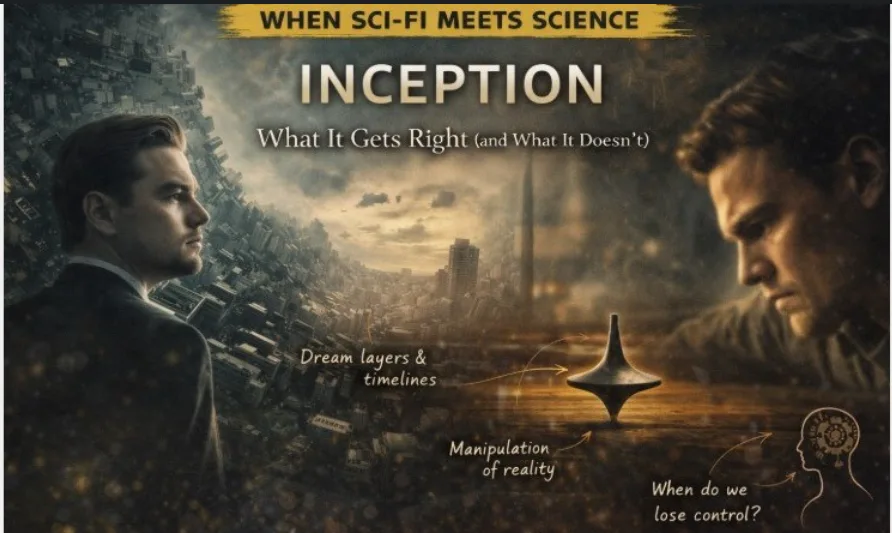
When dreams start feeling structured
Dreams usually feel unpredictable.
They shift suddenly, change settings without warning, and rarely follow a clear sequence. You don’t plan them. You don’t control them. You just… experience them.
Inception presents something very different.
Dreams become structured environments. Designed spaces. Places that can be entered, shared, and even layered within each other.
That’s where the idea becomes interesting.
Because while dreams are real, the level of control shown in the film is not.
Can we control dreams like that?
There is a real concept called lucid dreaming.
It happens when a person becomes aware that they are dreaming, and in some cases, can influence what happens next. People can change environments, make decisions, and interact more consciously within the dream.
So the idea of controlling dreams isn’t entirely fictional.
But it’s limited.
Lucid dreaming:
- doesn’t happen consistently
- requires training
- doesn’t allow full control over every detail
You can influence a dream.
You can’t design it like an architect.
The idea of shared dreaming
One of the central concepts in Inception is that multiple people can enter the same dream and experience it together.
This is where the film moves firmly into fiction.
There is currently no scientific evidence that dreams can be shared between individuals. Dreams are generated by the brain’s internal activity, influenced by memory, emotion, and neural patterns.
They are private experiences.
We can describe dreams to others.
We cannot invite them in.
Dreams within dreams
The film builds heavily on the idea of layered dreams, where one dream exists inside another, each with its own timeline.
Interestingly, the concept of time distortion in dreams is somewhat grounded.
People often report that dreams feel longer or shorter than real time. The brain processes information differently during sleep, which can create the feeling of stretched or compressed time.
But the extreme scaling shown in the film, where minutes turn into hours or years across layers, is exaggerated.
It’s a narrative device, not a scientific one.
Planting ideas inside the mind
The central mission in Inception is not stealing information, but planting an idea so deeply that it feels like the person’s own.
This is called “inception” in the film.
While the exact method is fictional, the underlying concept isn’t entirely impossible.
Human thoughts are influenced constantly by:
- suggestion
- repeated exposure
- emotional experiences
Ideas can feel self-generated even when they are not.
But this happens gradually, not through a single, precise event inside a dream.
The film compresses a slow psychological process into a controlled operation.
Where the science holds, and where it doesn’t
Inception borrows from real ideas:
- lucid dreaming
- time distortion in dreams
- psychological influence
But it builds a system around them that doesn’t exist.
There is no technology that allows:
- entering dreams on demand
- designing them in detail
- sharing them with others
- or controlling their structure completely
The science provides inspiration.
The system itself is fictional.
Why it still feels believable
Even though the mechanics aren’t realistic, the film doesn’t feel random.
That’s because it stays consistent with its own rules.
Once you accept the premise, everything follows logically within that framework.
And more importantly, it builds on experiences we already recognise.
We’ve all had dreams that felt real. We’ve all woken up confused about what was real and what wasn’t.
The film just takes that feeling and expands it.
What the film is really exploring
Inception isn’t trying to prove that dreams can be engineered.
It’s exploring something closer to perception.
How easily reality can feel unstable.
How memory, emotion, and belief can blur the line between what is real and what only feels real.
The final question it leaves behind
If something feels real while you’re experiencing it, does it matter that it isn’t?
Science has a clear answer.
Yes, it does.
But experience doesn’t always follow logic.
And that tension is what the film builds on.
(Next: a film that doesn’t just question dreams, but reality itself — what if everything you experience is already constructed?)