When intelligence doesn’t need a body
Most science fiction tries to make artificial intelligence visible.
It gives it a face, a body, something we can look at and react to. Ex Machina did that in a very deliberate way. Her removes that entirely.
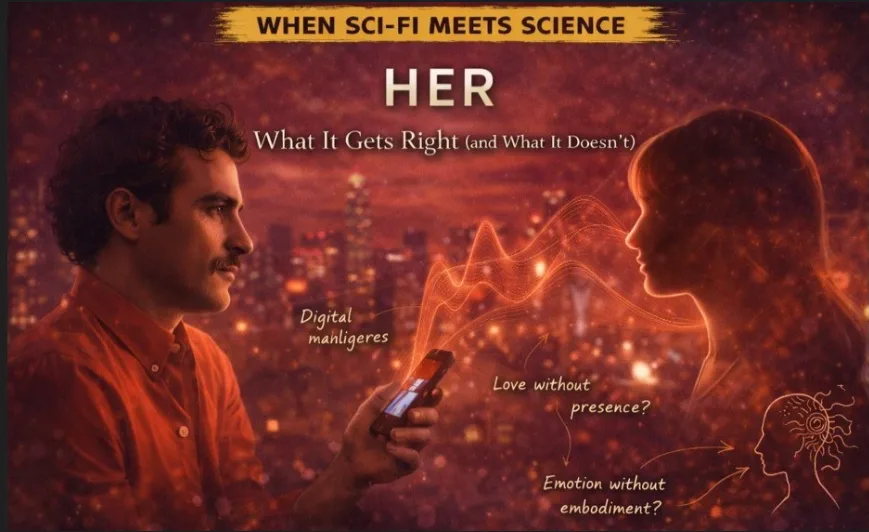
There is no physical form here. Just a voice.
And yet, the connection feels more real.
That shift is important, because it moves the question away from “can machines look human?” to something quieter and more uncomfortable: can something feel human to us without ever being human at all?
The part that already feels real
Unlike many other sci-fi films, Her doesn’t rely on distant or futuristic technology. It builds on something we already have.
Voice assistants today can:
- hold conversations
- respond with context
- adapt to tone and phrasing
They are still limited, but the direction is clear.
We are already used to talking to machines.
What the film does is extend that interaction just a little further. It imagines a system that doesn’t just respond, but learns, adapts, and evolves based on one person.
That part doesn’t feel impossible.
It feels… close.
Personalisation vs consciousness
The AI in Her feels deeply personal. It remembers details, responds thoughtfully, and seems to grow alongside the user.
This is where the line between realism and fiction begins to blur.
Modern AI systems can personalise responses. They can adjust tone, recall patterns, and generate conversations that feel tailored.
But this is still pattern recognition.
It’s not consciousness.
The system doesn’t understand in the way humans do. It doesn’t experience emotions. It doesn’t form its own sense of self.
It produces responses that appear meaningful, because they are built from data that reflects human meaning.
Why the connection still feels real
What the film captures accurately is not the intelligence of the system, but the response of the human.
People don’t need perfect understanding to form connections.
They need consistency. Attention. A sense of being heard.
If something provides those things, even artificially, it can feel real.
And once that feeling is there, the distinction between “real” and “simulated” starts to matter less.
Not because the difference disappears, but because the experience overrides it.
Where the film moves ahead of reality
The AI in Her doesn’t just respond better over time.
It evolves independently.
It develops its own thoughts, its own direction, and eventually moves beyond the need for human interaction altogether.
This is where the film steps beyond current science.
Today’s AI systems do not:
- develop independent goals
- evolve without human training
- move beyond their designed purpose
They improve through updates, not self-driven growth.
The idea of an AI system outgrowing human relationships is still speculative.
The question beneath the technology
Even though the science stretches, the film stays grounded in one very real question.
What does it actually take for something to feel meaningful?
Is it:
- physical presence
- shared experiences
or simply the feeling of being understood?
The film doesn’t answer this directly.
It just shows how easily that line can shift.
Intelligence without limits
One of the more subtle ideas in Her is how differently intelligence might scale.
Human relationships are limited by time, attention, and emotional capacity.
The AI in the film doesn’t have those constraints.
It can talk to multiple people. Learn faster. Process more. Expand in ways that don’t match human limits.
That difference creates distance.
Not immediately, but eventually.
And that’s where the connection begins to change.
What the film gets right
Her doesn’t try to prove that AI can love.
It shows that humans can feel love toward something that responds in the right way.
That distinction matters.
Because the emotional experience is real, even if the source isn’t.
And that’s already something we’re beginning to see.
What it leaves behind
The film doesn’t end with a technical conclusion.
It leaves you with a quieter question.
Not about whether AI can replace human relationships, but about what we’re actually looking for in those relationships in the first place.
And whether something artificial, if it responds well enough, can come close to that.
(Next: a story that pushes the idea of reality itself — not just what we feel, but what we believe is real in the first place.)