A robot cleaning a dead planet
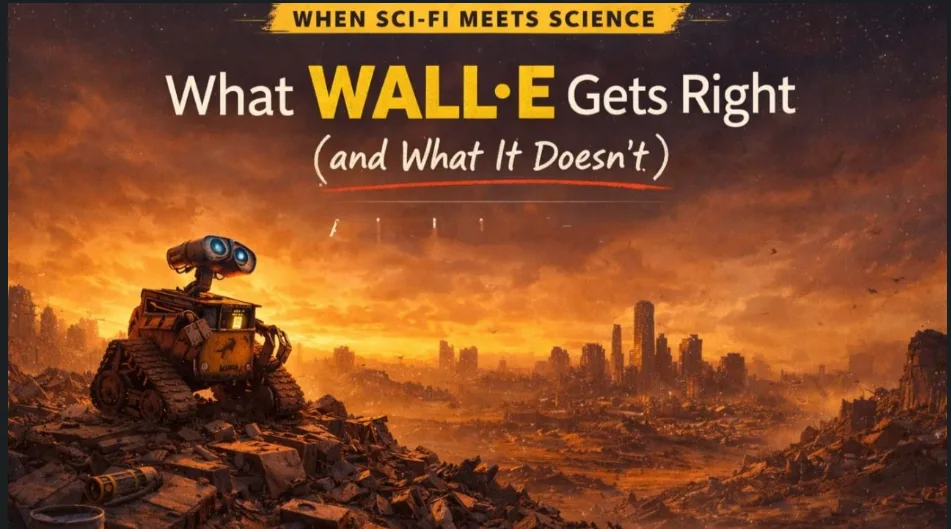
At first glance, WALL-E looks like a quiet children’s movie about a lonely robot cleaning trash on Earth.
But underneath the silence and rusted metal, it’s actually asking a very big question:
What happens to a planet if humans stop taking care of it?
In the movie, Earth has been abandoned after centuries of runaway consumption. Mountains of garbage cover the planet. Humans now live in space aboard enormous automated ships while small robots are left behind to clean the mess.
The last one still functioning is WALL-E.
And strangely enough, a lot of the science behind this setup isn’t completely ridiculous.
Could Earth actually become that polluted?
The towering walls of compacted trash in the movie feel exaggerated, but the underlying idea isn’t entirely fictional.
Modern landfills already hold billions of tons of waste, and global waste production continues to grow every year. If consumption kept accelerating without proper recycling or management, the environmental impact could become catastrophic.
However, the specific scenario in WALL-E—where the entire planet becomes an unlivable landfill—is unlikely.
Pollution tends to spread unevenly. Ecosystems collapse gradually, not all at once. Even heavily polluted regions usually still support some form of life.
In reality, Earth is surprisingly resilient.
Nature has an incredible ability to recover once pressure is removed.
The surprisingly realistic robots
WALL-E himself is actually one of the more believable parts of the film.
Modern robotics already includes machines that:
- navigate environments autonomously
- perform repetitive maintenance tasks
- operate for long periods without human supervision
For example, warehouse robots, planetary rovers, and automated cleaning systems all use similar ideas.
The biggest difference is durability.
In the movie, WALL-E has survived for hundreds of years, which is far beyond the lifespan of any current machine. Mechanical parts degrade, electronics corrode, and energy systems eventually fail.
Real robots require regular maintenance.
Even NASA’s Mars rovers, which are designed for extreme environments, rarely last more than a decade.
Humans living permanently in space
The film imagines humans moving to giant space habitats after Earth becomes uninhabitable.
That idea actually has roots in real scientific proposals.
Physicists like Gerard O’Neill proposed massive rotating space habitats in the 1970s that could simulate gravity using centrifugal force. In theory, such structures could support large populations.
But the scale required in WALL-E is enormous.
Supporting millions of humans in space would require vast amounts of energy, food production, water recycling, and radiation protection.
We currently struggle to keep a few astronauts alive on the International Space Station for extended periods.
A full human civilization in space would require technological breakthroughs we haven’t achieved yet.
What the movie gets emotionally right
Where WALL-E is most accurate isn’t in the engineering.
It’s in the behaviour.
The story suggests that technological convenience can slowly distance humans from the systems that sustain them. People become passive. Automation handles everything. Curiosity fades.
Eventually, no one remembers how the world used to work.
That idea feels uncomfortable because it doesn’t require futuristic technology to begin.
It just requires small habits repeating over time.
Why stories like this matter
Sci-fi doesn’t have to be perfectly accurate to be valuable.
Sometimes it acts more like a thought experiment.
It asks: what direction are we moving in, and what might happen if we never course-correct?
WALL-E exaggerates reality in order to make us notice it.
And maybe that’s the real role of science fiction.
Not predicting the future perfectly.
Just making us curious enough to think about it.