When space stops feeling empty
Space is often shown as silent and calm. Vast, empty, almost peaceful. Gravity takes that image and turns it into something else entirely. The moment things start going wrong, space doesn’t feel empty anymore. It feels hostile.
Not because something is chasing the characters, but because there is nothing to hold on to. No air, no resistance, no margin for error. Every movement matters. Every mistake carries forward.
That shift is what makes the film work. It doesn’t add danger to space. It simply shows what’s already there.
The part the film gets right
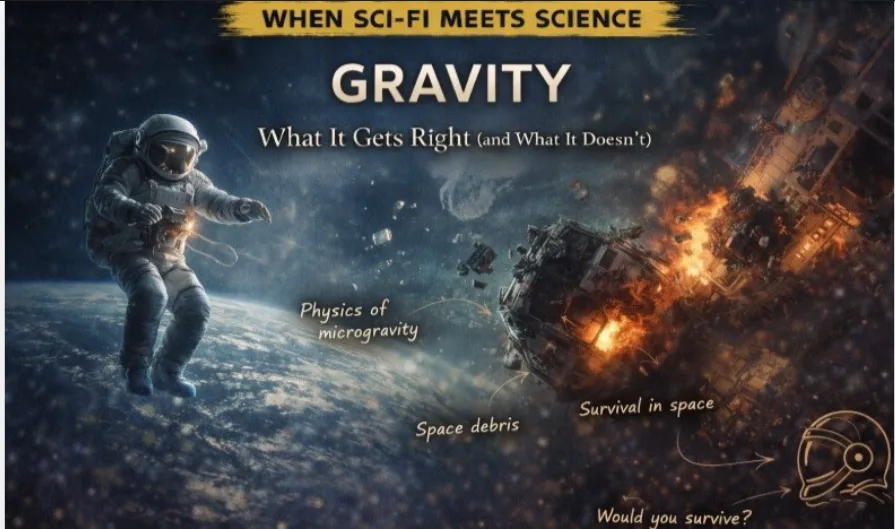
One of the most accurate aspects of Gravity is how motion behaves in space. Once something starts moving, it keeps moving. There is no air resistance to slow it down, no natural way to stop or stabilize without external force.
The film captures this well. Objects drift. Debris continues on its path. A small push can send someone spinning, and stopping that motion becomes difficult without precise control.
This is consistent with real physics. In microgravity, movement is governed by inertia. You don’t “stand still” unless something actively holds you in place.
The chain reaction problem
The debris storm shown in the film is based on a real concept called the Kessler Syndrome. It describes a situation where collisions in orbit create fragments, which then collide with other objects, creating even more debris.
This part is grounded in real concern. Space agencies actively track debris because even small fragments can cause serious damage due to the high speeds involved.
However, the film exaggerates how frequently these debris waves occur. In reality, while debris is dangerous, it wouldn’t repeatedly circle back in such tight intervals the way it does in the movie.
The idea is real. The timing is dramatized.
Movement between space stations
The film shows characters moving between different space stations with relative ease. While this works for storytelling, it stretches reality.
Orbital mechanics are complex. Space stations are not just floating nearby. They are moving at extremely high speeds, often in different orbits and directions.
Reaching another station isn’t just about getting there physically. It requires precise calculations, matching velocity, and careful trajectory planning.
You can’t simply “aim” yourself and drift across.
Sound, silence, and perspective
One of the more accurate choices in Gravity is the treatment of sound. In space, there is no medium for sound to travel, so external explosions and collisions are silent.
The film reflects this, often muting external noise and relying on vibrations or internal audio instead.
This detail, while subtle, adds to the realism. It reminds you that space doesn’t behave like Earth, even in basic ways.
Where the film bends things
Despite its realism, Gravity takes liberties with how long a person can survive in extreme conditions. Oxygen levels, temperature changes, and exposure to vacuum are simplified to keep the story moving.
In reality, space is far less forgiving. Even small delays or minor miscalculations could be fatal much faster than the film suggests.
The film doesn’t ignore these dangers. It just makes them slightly more survivable.
Survival without control
What makes Gravity different from something like The Martian is the lack of control.
In The Martian, problems can be broken down and solved step by step. There is time to think, plan, and adjust.
In Gravity, survival is more immediate. It’s about reacting, stabilizing, and holding on long enough to reach the next step.
The science is still there, but the margin for error is much smaller.
What the film gets right overall
Gravity doesn’t try to explain space in detail. It focuses on what it feels like to be there when things go wrong.
And in that sense, it stays close to reality.
Space isn’t dangerous because something is attacking you.
It’s dangerous because there is nothing there to save you if you make a mistake.
(Next: we move back to something quieter — not survival, not physics, but connection again, in a way that feels much closer to home.)