A future that doesn’t explode, but slowly fades
Most disaster movies begin with something dramatic.
An asteroid. An invasion. A sudden collapse.
Interstellar begins with something quieter
Crops stop growing the way they used to. Dust storms return. Farming becomes harder every year, and people slowly realise the planet may not be able to feed them forever.
Nothing spectacular happens. The world simply starts becoming less livable.
That idea feels unsettling because it doesn’t look like science fiction at all.
Agriculture depends on systems that are surprisingly delicate — soil health, biodiversity, stable climate patterns. When those systems begin to shift, the effects can spread quietly before anyone fully understands what’s happening.
The film speeds this process up, of course. Ecosystems rarely collapse that quickly.
But the fear behind it isn’t imaginary.
Civilization depends on a stable planet more than we usually notice.
The black hole that scientists helped design
One of the most memorable images in Interstellar is the black hole called Gargantua.
What makes it interesting is that the filmmakers didn’t just invent how it should look. They worked closely with theoretical physicist Kip Thorne while designing it.
The glowing ring around the black hole is matter spiraling inward — something astronomers call an accretion disk
But what makes the image look strange is how the light behaves around it.
Near a black hole, gravity becomes so strong that even light doesn’t move in straight lines anymore. Light from the far side of the disk bends around the black hole, appearing above and below it.
It looks surreal on screen.
But it’s actually what Einstein’s equations say should happen near extreme gravity.
Sometimes the real universe already looks stranger than anything we might invent.
When gravity slows down time
One of the film’s most famous ideas appears on Miller’s planet.
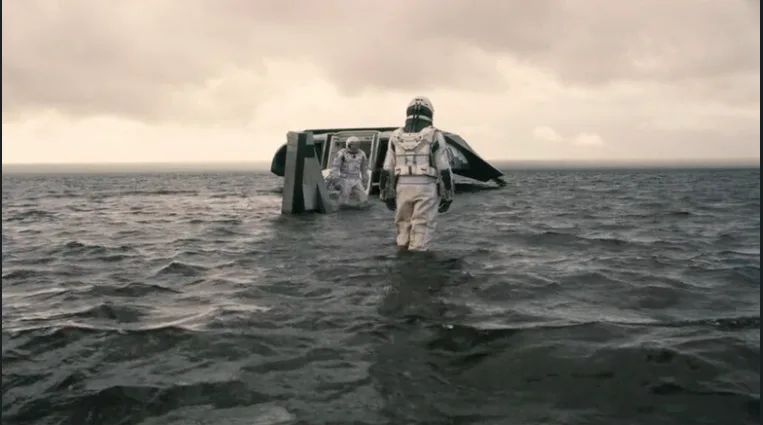
Because the planet orbits extremely close to Gargantua, time passes very differently there. One hour on the planet equals seven years back on Earth.
It sounds like pure science fiction.
But the idea comes directly from Einstein’s theory of general relativity.
The closer you get to something with enormous gravity, the slower time begins to move compared to places farther away.
This isn’t just theory, either.
Even here on Earth, time moves slightly differently depending on gravity. GPS satellites experience weaker gravity than the surface of the planet, so their clocks tick a little faster. Engineers have to correct for this difference constantly.
Otherwise your navigation system would slowly drift off course.
Interstellar simply pushes this real effect to a much more extreme situation.
Near something as massive as a black hole, time itself starts acting a little differently.
Wormholes as shortcuts through space
In the movie, the astronauts travel to distant star systems through a wormhole that appears near Saturn.
A wormhole is essentially a theoretical shortcut through spacetime — a tunnel connecting two distant regions of the universe.
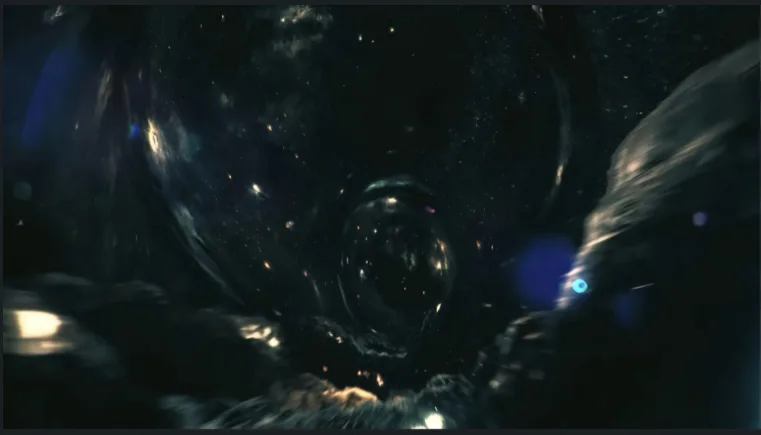
Physicists didn’t invent the idea for science fiction. It actually appears in certain solutions to Einstein’s equations.
In theory, if a wormhole existed and stayed stable, it could allow travel across enormous distances without crossing all the space in between.
But there’s a problem.
Most models suggest wormholes would collapse almost instantly unless they were held open by forms of matter we’ve never observed.
So wormholes exist in equations for now.
No one has ever seen one. And we definitely don’t know how to travel through one.
Where the movie stretches reality
Even though Interstellar takes physics seriously, it still bends the rules in a few places.
Surviving inside a black hole is almost certainly impossible. The gravitational forces near the event horizon would tear apart a spacecraft long before reaching the interior.
Some planetary environments in the movie are also simplified so the story can move forward.
But unlike many science-fiction films, Interstellar doesn’t ignore physics.
It starts with real scientific ideas and then pushes them just far enough to tell a story.
When physics starts shaping the story
One of the interesting things about Interstellar is that the science isn’t just decoration.
The physics actually shapes the story itself.
Gravity bends light. Gravity bends time.
And once time starts behaving differently, the distance between past, present, and future begins to blur a little.
The universe in the film isn’t magical.
It’s simply following its own rules — rules that turn out to be stranger than we expected.
(Part 2 will explore one of the film’s most unusual ideas: the possibility that human connection might still matter even when time itself behaves differently.)