Alone, until you’re not
At the beginning, the situation feels familiar.
One person, isolated in space, trying to survive with limited resources and even less certainty. It almost feels like The Martian again, just placed a little farther from home.
But then something shifts.
He’s not alone.
And suddenly, the hardest part isn’t survival anymore. It’s understanding.
The problem no one prepares you for
Most stories treat communication as something that can eventually be figured out. Different languages might slow things down, but there is always some shared ground to start from.
Here, that assumption disappears.
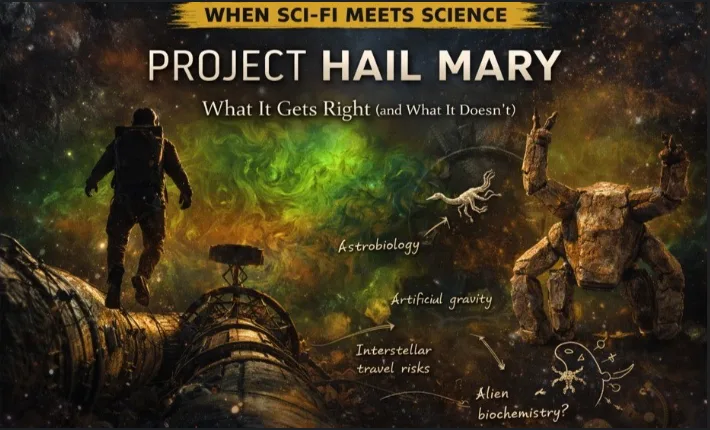
The being he encounters doesn’t think like him, doesn’t perceive the world the same way, and doesn’t come with anything resembling human language. There are no words to translate, no gestures to rely on, no cultural overlap to lean on.
There is no common starting point.
Just two entirely different systems trying to recognise each other as something worth understanding.
Starting with what doesn’t change
So the process doesn’t begin with language.
It begins with patterns.
Instead of asking what something means, the focus shifts to what stays consistent. Sounds are repeated. Responses are observed. Small connections are guessed and then tested again.
This is where the idea becomes interesting.
Patterns don’t belong to any one species. Numbers, rhythms, and structures exist independently of who is observing them. They don’t require translation in the same way words do.
And that makes them the closest thing to a shared language.
Building meaning, slowly
Nothing in this process is immediate.
Each step forward is small, uncertain, and sometimes wrong. A sound might mean something, or it might not. A pattern might be understood correctly, or completely misinterpreted.
But progress doesn’t come from getting it right the first time.
It comes from trying again.
Over time, these small attempts begin to form something usable. Not a complete language, not perfect understanding, but just enough clarity to move forward.
And that’s all they need.
Why science becomes the bridge
What makes this possible isn’t emotion or instinct.
It’s science.
Both sides, in their own way, understand the same physical world. Numbers behave the same. Measurements stay consistent. Cause and effect still follow patterns.
This becomes the shared ground.
Not because they chose it deliberately, but because it’s the only thing that doesn’t depend on being human.
Science doesn’t belong to us. It describes the universe itself, and that makes it accessible to anything capable of observing it.
From solving problems to sharing them
This is where the story quietly shifts.
In The Martian, survival depended on solving problems alone, breaking them down until they became manageable.
Here, the problem is bigger than one person can handle.
And more importantly, it’s no longer just about solving it.
It’s about solving it together.
That changes everything.
Because now, understanding isn’t optional. It’s necessary.
A different kind of connection
What makes this part of the story stand out isn’t that communication eventually happens.
It’s how it happens.
Slowly, through repetition and correction. Through patience more than brilliance. Through a willingness to keep trying even when nothing seems to be working yet.
There’s no shortcut to it.
No moment where everything suddenly makes sense.
Just gradual progress built on effort.
What stays after everything else
The film doesn’t present communication as something clean or perfect.
It shows it as something built.
Piece by piece, through shared effort and a bit of uncertainty.
And maybe that’s what makes it feel believable.
Not the idea that two completely different beings can understand each other.
But the idea that they would keep trying until they do.
(Next: a film that takes communication even further — not just understanding another being, but understanding time itself.)