When language feels bigger than words
Most of the time, language feels like a tool.
We use it to communicate, to explain things, to translate thoughts into something shareable. It feels separate from how we actually experience the world.
Arrival challenges that idea.
It suggests that language might not just describe reality. It might shape how we perceive it.
That idea isn’t completely fictional.
But the film takes it much further than science currently supports.
The part the movie gets right
One of the most grounded parts of Arrival is how difficult communication actually is.
The film doesn’t treat translation as instant. There are no magical devices that decode everything in seconds. Instead, it shows how meaning has to be built slowly, through repeated observation and testing.
This is exactly how real-world linguistics works.
When researchers encounter an unknown language, they don’t start with words. They start with patterns. Sounds are repeated, associations are observed, and meaning is gradually constructed over time.
Even the idea that different languages structure thought differently has some scientific basis.
Languages influence how we:
- categorize objects
- describe time
- focus attention
This is loosely based on the Sapir-Whorf hypothesis.
But here’s where things begin to shift.
Where the movie stretches the science
The film suggests that learning a new language could fundamentally change how you experience time.
Not just how you describe it.
But how you perceive it.
In Arrival, understanding the alien language allows the main character to experience future events as if they were memories.
This is where the science breaks.
There is no evidence that language can alter our perception of time in that way. While language can influence how we think about time, it doesn’t change the direction in which we experience it.
Time, as far as we know, still moves forward.
Always.
The structure of the alien language
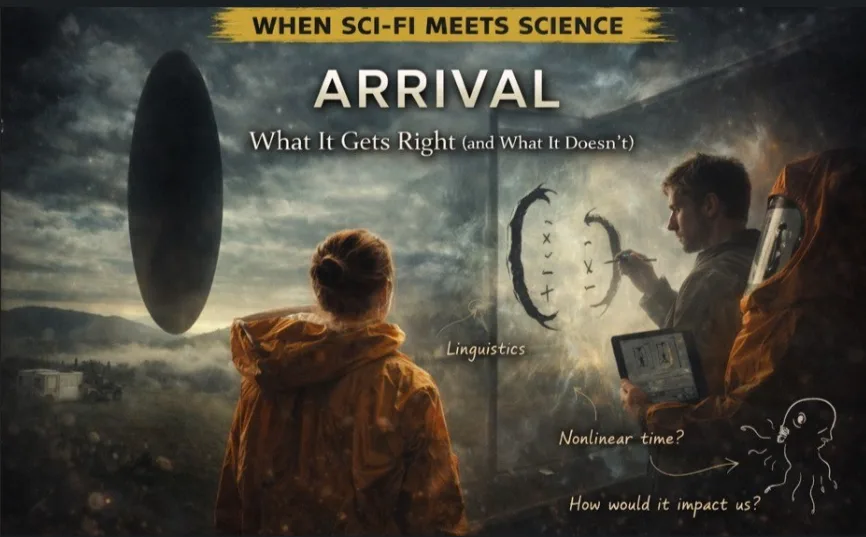
The circular symbols used by the aliens are one of the most interesting parts of the film.
Unlike human language, which unfolds in sequence, their language appears to exist all at once. Each symbol represents a complete idea rather than a string of smaller parts.
This is imaginative, but not entirely disconnected from reality.
Some human languages rely less on strict word order and more on context or structure. But even then, they are still processed over time.
We don’t have any known language that allows meaning to be understood instantaneously as a whole.
So while the concept is creative, it’s not something supported by current linguistics.
The idea behind it still matters
Even though the time aspect isn’t scientifically accurate, the film is built on a real question:
How much does language influence thought?
And the answer is: somewhat, but not completely.
Language can guide attention and shape perception, but it doesn’t override basic physical experience.
You won’t start seeing the future just because you learned a new grammar system.
Unfortunately.
Science vs story
Arrival starts with real ideas about communication and cognition.
Then it stretches them.
Not randomly, but deliberately.
It uses science as a foundation, and then builds a story on top of it.
That’s what makes it work.
Because even when it stops being accurate, it doesn’t feel careless.
It feels like a question taken a little further than science can currently go.
What the film leaves you with
The most interesting part of Arrival isn’t whether its science is perfectly correct.
It’s how it makes you think about language differently.
Not just as something we use, but as something that quietly shapes how we understand the world.
Even if it doesn’t bend time.
(Next: a film that brings the question closer to home — not how we understand something alien, but whether we would recognise intelligence if we created it ourselves.)