The part where science stops feeling enough
For most of Interstellar, the film stays very close to physics.
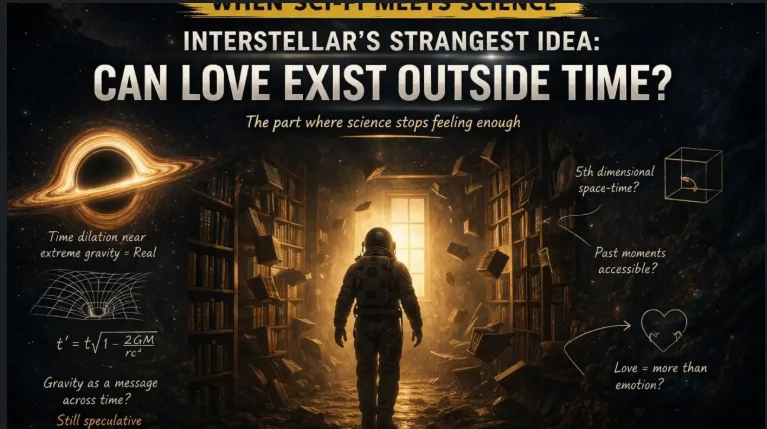
Black holes behave the way they should. Time slows down near gravity. Space travel follows rules that feel real.
And then, slowly, the film begins to move somewhere else.
Not away from science. Just… beyond what science can comfortably explain.
A room built out of time
Near the end of the film, Cooper finds himself inside the black hole.
Instead of darkness, he sees something unexpected.
A structure. A space that looks like a room, but isn’t really a room.
It’s made of moments.
Different points in time exist together, like shelves you can move through. The past isn’t gone anymore. It’s just… accessible.
It’s one of the strangest ideas in the film.
Because it takes something we experience as fixed - "time" - and turns it into something you can move through.
Physics allows for the possibility that time isn’t as simple as we perceive it. But what the film shows here is more than physics.
It’s imagination built on top of it.
Communicating across time
From inside this space, Cooper tries to reach Murph.
Not through speech. Not directly.
But through gravity.
He moves objects. Sends signals. Repeats patterns.
And somehow, across years, those signals reach her.
This is where the film stretches science the most.
We don’t know of any way to send meaningful information backward through time. The idea that gravity could be used like this is, at best, speculative.
But the film isn’t really trying to prove that this is possible.
It’s trying to explore something else.
Why it doesn’t feel completely absurd
What makes this part of the film interesting isn’t whether it’s scientifically accurate.
It’s that it doesn’t feel random.
Cooper doesn’t try to contact just anyone. He reaches for Murph.
Not because she’s convenient.
Because she matters.
The film quietly suggests that when everything else becomes uncertain: distance, time, even reality; relationships remain the only thing that still feels fixed.
Not as a force of nature.
But as a kind of direction.
The idea that doesn’t quite fit, but stays anyway
At one point, Amelia Brand says something that feels out of place in a film built on physics.
She suggests that love might be something more than emotion. Something that can transcend time and space.
It sounds almost unscientific.
And maybe it is.
But the film doesn’t try to prove her right in a technical sense.
Instead, it shows characters making decisions based on connection, memory, and trust — even when logic alone isn’t enough.
So the idea lingers.
Not as a theory.
But as a possibility the film refuses to dismiss.
What the movie might actually be saying
Interstellar doesn’t claim that love bends gravity.
It does something quieter.
It places human connection inside a universe that behaves in ways we barely understand, and asks whether that connection still matters there.
When time stretches, when distances become meaningless, when cause and effect stop feeling linear…
what do we hold on to?
In the film, the answer isn’t a formula.
It’s a relationship.
A different kind of science fiction
Most science fiction tries to imagine new technology.
Interstellar does that too.
But it also asks a more uncomfortable question:
If the universe is this vast, this strange, this indifferent… what keeps us grounded?
The film doesn’t answer it directly.
It just shows us what the characters choose.
And leaves us to decide whether that choice makes sense.